
How can you get closer to your purpose?
FINDING MEANING
The “IKIGAI” formula is often presented as THE solution… But what does it really entail?
Everyone is talking about Ikigai these days. Although there is no direct English translation, “Ikigai literally consists of iki (to live) and gai (reason).”
The Japanese concept of ikigai may indeed help people discover their purpose—their motivation for getting up in the morning. The growing fascination among Westerners with Eastern culture, combined with the search for meaning and a higher purpose, may explain this trend.
Based on Western methods, which draw on this Japanese concept, if you are clear about:
what you love,
what you're good at,
Ways to Monetize Your Action
ways to address global and societal challenges…
… Jackpot! You've found your ikigai.
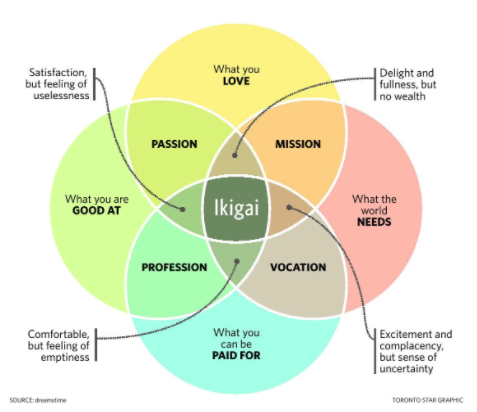
Principles of Ikigai - Diagram
There are only four parameters to experiment with, and then you can sleep soundly knowing you have a reason to wake up in the morning.
The theory is clever and appealing:
It is simple and yet comprehensive
It implies that you can love what you do, contribute to society, and still thrive and prosper
It reinforces the importance of engaging in activities that energize you and fully immerse you in the joy of your creativity (i.e., this is called the “flow state”).
That being said, if you’re like me and most of my clients, chances are you might not find it that easy to answer the questions above. It may even be difficult to strike the right balance between all four of these factors. The Westernized Ikigai method reminds me of some consulting solutions that seem practical on paper but are actually quite complicated to implement on your own. Or, if you prefer, the promise of the magic mirror in Disney’s *Snow White and the Seven Dwarfs*. One reason for this may lie in our Western desire for efficiency and quick results.
The Japanese meaning of "ikigai" may both disappoint and reassure you
Having lived in Japan, I have always felt a bit perplexed when faced with such ecstatic enthusiasm for the concept of ikigai. While Japanese culture places great emphasis on collective continuous improvement (Kaizen), I rarely saw Japanese colleagues overly obsessed with their personal development or their personal contribution to the world through their work. Numbers speak louder than words: In a 2010 survey of 2,000 Japanese men and women, just 31% of participants cited work as their ikigai. That’s not a very significant proportion for the birthplace of ikigai, is it?
Rather than a quick fix for individuals’ sense of purpose and career development, this concept perfectly reflects the Japanese way of life—complex, subtle, yet down-to-earth. Ikigai calls for a slow life rather than a successful career. It is a very democratic and down-to-earth concept of life, open to everyone, and disconnected from the Western view of success.
Neuroscientist and best-selling Japanese author Ken Mogi presents five pillars to help you become your most authentic self:
start small
set yourself free
embrace harmony and sustainability
cherish the joy of the little things
be in the here and n
“Ikigai lies in the realm of small things (...) “Hanami—when the Japanese admire the blooming of the cherry blossoms every spring—is a prime example. You cannot hold on to the experience, and it brings you fleeting joy.”
In other words, you appreciate what gives life meaning when you appreciate the experience of the here and now, when you reconnect with nature, and when you let yourself be part of the larger ecosystem around you.
One might then ask: Is it our calling to be in a state of meditation in our daily lives? To live purposefully, should we avoid the endless cycle of career-building and self-development?
Humility, authenticity, and courage open the door to your purpose
To find your purpose, dare to accept who you are —with your talents, hopes, fears, and areas for growth (not all of which need to be developed!). Being humble enough to understand that you are part of a larger ecosystem is a good start. Knowing how to push yourself to make the most of your unique strengths and the complementary resources at your disposal is another step.
Exercise your free will. On this point, Western and Japanese definitions are in agreement:
“You cannot and should not blame your circumstances for a lack of ikigai. After all, it is up to you to find your own ikigai, in your own way.” (Ken Mogi).
“If you do something on purpose, you do it intentionally, not by accident” (Cambridge)
Recognize that your higher purpose continues to evolve, just as you and your environment do. This is a complex system that cannot be resolved once and for all. Preserve your well-being and joy while pursuing your purpose. Striving to achieve your purpose while sacrificing your health, personal relationships, and self-esteem may not be rational. Yet this is what many people do.
My friend Marie would say, “Stop thinking you’re running up a mountain when you’re actually running on a treadmill.”
Most importantly, you may want to find a balance in all the important areas of your life to ensure that you are living—and will continue to live—happily, sustainably, and with purpose!
When it comes to your career, rather than being the Head of Strategy, how about being the Operator of your meaningful career? Dare to face the reality on the ground. Focus on who you are right now, the kind of world and lifestyle you want to strive for, and the concrete steps you can take to bridge the gap. Of course, circumstances may vary from one situation to another, but your personal intentions should remain the same. Strategies, money, and success should simply be the results of your personal and inner alignment—not the reasons you take action.
UPDATING YOUR CHANGE
A simple tool
Summarizing this purpose in a mantra will serve as a long-term, evolving compass, guiding you along the path you create for yourself.
How and where to start?
It may seem overwhelming and abstract to many people. Here are a few steps that may help you put the different pieces of the puzzle together. I invite you to set aside your judgment, trust your gut, and ask yourself:
What are the top 3–5 elements that need to be balanced to make you happy in life?
What are your own deepest hopes for the world in the future? (You may want to draw or write down 3–5 characteristics that describe the ideal world you want to live in.)
What are my strengths, and what role should I play to turn that dream into a reality?
Once you’re done, you can complete this summary: “I long for a [adjectives] world, where I can find a balance between [nouns], [nouns], and [nouns]. To achieve that goal, my mission is to [verb]. I draw on my [nouns of talents] to make it happen.”
Here is an example: “I long for a humanistic and nature-centered world, where I can achieve a fulfilling balance between my well-being, family, work, intellectual discoveries, and social connections. To that end, my mission is to serve as a catalyst for individual and collective change, so as to position Purpose as a driver of positive impact and serenity. To do so, I draw upon my vision, creativity, connectedness, and listening skills.”
Whenever you're faced with a new decision, ask yourself:
Is it in line with my purpose?
Will this choice allow me to find contentment in the present moment?
How can I better balance the essential factors that make me who I am?
A quote
“‘Thereis no single best way to find ikigai. Each of us must seek our own, in the forest of our unique individualities .’”
Over to you
What is your mantra?
Do you need someone to help you shed light on your path to discovering the many possibilities that await you? Contact me!
