

FOOD FOR THOUGHT

CHANGEMAKER'S TOOL: From Whistleblower to Life Leader
I'm writing a series of articles about tools that I've tested myself as a leader, change-maker, mother, and entrepreneur. I promise they're quick, simple, and effective—and can even inspire beautiful transformations—if you commit to practicing them daily or as often as possible.
💡THE PROBLEM: LACK OF engagement
Many of my clients, who are change agents, tell me how frustrated they are with their colleagues: “I don’t understand. Despite all my arguments, I can’t convince them. They don’t understand. In any case, they don’t want to change.”
Having a coherent, well-structured message is crucial, but it's not enough.
Often, the real barrier to engagement goes beyond the words we choose. The influence we exert depends, above all, on the reality we offer people a glimpse of.
Let me give you an example:
If your manager seems burned out, overwhelmed, and neglecting his personal life, you probably wouldn't want to be in his shoes (even if the challenge and status might be appealing).
If they seem fulfilled and able to strike a balance between their work and personal life, you might be tempted to consider this option.
The real problem with a lack of commitment lies in the model we embody.
Engaging others is, above all, about inspiring them to join us on our journey, and that comes from the energy we radiate by simply being ourselves.
🔍 THE TOOL: THE LIFE LEADER MODEL
“BE THE CHANGE YOU WANT TO SEE IN THE WORLD” — MAHATMA GANDHI
How many people have tried to raise awareness by talking about the dramatic consequences of climate change? This is indeed a crucial point to share.
But few people make a long-term commitment once they have become aware of the problem. Fear is too strong and often leads people to inaction or denial.
To create a movement, it is essential to craft an inspiring story. But this story will only be truly inspiring if the speaker embodies—in his or her own way and with all his or her imperfections—the desired change.
The key to engaging others is to become a leader who inspires desire.
Let me explain. A desire leader is someone who:
Reconnects with the life within them, with their deepest inner desires.
They dare to be themselves, with all their talents and vulnerabilities.
They contribute to the world in their own unique way, guided by a meaningful and ambitious mission.
It makes you want to join them on their adventure.
Inspires individuals to reconnect with themselves and find their place in the movement.
🐝 YOUR CHALLENGE: BECOME A LIFE LEADER
If you're still with me (thank you, by the way), you're probably wondering, "OK, but specifically, what do I do?"
I suggest you take 2–3 minutes in a quiet place and ask yourself these questions:
How has my energy level been over the past 2–3 months?
How much do I feel like I belong?
When do I feel ALIVE?
Do my missions still make sense?
Where am I going?
To what extent do the model I advocate align with my actions and the way I live my day-to-day life?
If the gap is too wide or if you don't know how to answer these questions, what's the first step in refocusing yourself?
Let the answers come naturally. They will serve as signals—indicating whether you're on the right path for you
MY EXPERIENCE REPORT
When I took on the role of Sustainability Director, I was exhausted from trying to help everyone while pushing for more ambitious initiatives.
I thought that my role—raising awareness, providing support, and making proposals—would be enough to get my colleagues on board. In reality, I was tired and stressed. To be honest, I didn't really feel like “making the shift toward the ecological transition.”
When I started listening to myself and understanding my needs and desires, my life changed, and the people around me became more involved. I began to set an example that was inspiring. It wasn't perfect, but it showed that you can take care of yourself and still have a positive impact.
Someone said to me one day, “It’s because you’re like that that I let myself do it.” That was a “haha moment.”
My wish?
So that you may dare to be yourself and strive toward your higher purpose, so that others may do the same. In doing so, a movement will emerge without you even realizing it.
"So... ready to start?"
IF YOU FOUND THIS POST INSIGHTFUL, PLEASE LIKE IT AND SHARE IT WITH YOUR NETWORK. THAT'S THE BEST WAY TO SUPPORT ME.
Hi, Changemakers!
I am Nina, an impact maker coach specializing in leadership and sustainable transformation. For over 12 years, I have led sustainable change within a Fortune 500 organization in a multicultural environment. Through my work, I aim to inspire professionals in organizations to rethink business practices and help them take pride in contributing, in their own way, to a more sustainable, people-centered, and nature-friendly world. If you want to become an inspiring and impactful leader who engages your team and organization to create a better world, contact me!

Tool for "changemakers": Go from whistleblower to inspirational leader!
I’m writing a series of articles about tools I’ve tested and found to be effective in my roles as a leader, change agent, mother, and entrepreneur. I promise they’re quick, simple, effective, and can lead to wonderful transformations—if you stick with them over time.
💡THE PROBLEM: “a LACK of commitment”
Many of my clients—agents of change—share their frustration with me: “I don’t understand. Despite all my arguments, I can’t seem to convince them. They don’t get it. In any case, they don’t want to change.”
Having a coherent and well-structured argument is crucial, but it is not enough.
Often, the real obstacle to a lack of engagement goes beyond our choice of words. The influence we exert depends above all on the reality we present to others.
Let me give you an example:
If your manager seems exhausted, overwhelmed, and neglecting his or her personal life, it’s unlikely you’d want to be in his or her shoes (even if the challenge and the status might be appealing).
If he seems happy and able to strike a balance between his work and his personal life, you might be tempted to consider this option.
The real problem with a lack of commitment lies in the example we set.
Inspiring others to get involved means, above all, making them want to join us on our journey—and that comes from the energy we radiate simply by being ourselves.
🔍 The Tool: The Model of the Inspiring Leader
"Be the change you want to see in the world" - Mahatma Gandhi
How many people have tried to raise awareness by talking about the dramatic consequences of climate change? This is a crucial point that needs to be shared.
But few people commit to the long term after reaching this realization. Fear, which is too overwhelming, often leads to inaction or denial.
To create a movement, it is essential to craft an inspiring narrative. But that narrative will only be truly inspiring if the speaker embodies—in their own way and in their perfect imperfection—the change they seek to bring about.
The key to building engagement is to become a leader people look up to.
Let me explain. A leader people admire is someone who:
reconnects with the life within him, with his EN-VIES.
a journey toward daring to be oneself, with all one’s talents and vulnerabilities.
contributes in his own way to the world around him, driven by an ambitious and meaningful mission.
makes you want to join him on his adventure.
inspires a desire to reconnect with oneself in order to find one's rightful place within this movement.
🐝 YOUR CHALLENGE: BECOME A LEADER OTHERS LOOK UP TO
If you're still with me (thanks, by the way), you're probably wondering, "OK, but in practical terms, what do I do?"
I suggest you take 2–3 minutes in a quiet place and ask yourself these questions with unwavering kindness:
How has my energy level been over the past 2–3 months?
How much do I feel like I belong here?
When do I feel like doing something?
Do my assignments still have meaning?
What am I striving for?
To what extent do the model I advocate align with my actions and the way I live my daily life?
If the gap is too wide or if you don't know how to answer these questions, what's the first step to getting back on track?
Let the answers come naturally. They’ll guide you. It’s a “hot” or “cold” signal along your path—the one that’s right for you.
My Feedback
When I started my role as director of sustainable development, I was wearing myself out trying to help everyone while also pushing initiatives to be more ambitious.
I thought that my role—as a voice of warning, a source of support, and a driving force for change—would be enough to engage my colleagues. In reality, I was tired and stressed. Honestly, I didn’t exactly inspire people to “make the shift toward the ecological transition.”
When I started listening to myself and understanding my needs and desires, my life changed, and the people around me became more involved. I began to set an example that inspired others. It wasn’t perfect, but it showed that you can take care of yourself while making a positive impact.
Someone once told me, “It’s because you’re like that that I allow myself to do it.” That was a turning point.
My invitation?
Dare to be yourself and embrace your purpose so that others can do the same. A movement will emerge before you even realize it.
"So... Are you up for it or not?"
If you liked this post, please give it a "like" and share it with your network.
This is the best way to support me.
Hello to you, agents of change!
I’m Nina, an impact coach and committed board member, and an expert in leadership and sustainable transformation. I led transformation and sustainable development initiatives at Veolia for nearly 15 years, both in France and internationally. Today, what I love to do is help organizations and professionals rethink their business models and make them proud to contribute, in their own way, to a more sustainable, humane world that respects all life. If you want to be an inspiring leader and engage your team to maximize your impact, contact me!

CHANGEMAKER'S TOOL: WIN OVER ALLIES TO MAXIMIZE YOUR IMPACT!
I'm writing a series of articles about tools that I've tested myself as a leader, change-maker, mother, and entrepreneur. I promise they're quick, simple, and effective—and can even inspire beautiful transformations—if you commit to practicing them daily or as often as possible.
💡THE PROBLEM: LACK OF SUPPORT
When you drive change—especially if it's going to have a lasting impact—you're often out of step with the rest of the group.
At best, you elicit astonishment; at worst, you are met with mistrust or mockery.
Changes toward sustainability require collaboration with multiple stakeholders and organizational partners.
Nothing changes when you're isolated.
The challenges are systemic and too vast to be tackled alone.
I regularly hear my clients complain about feeling lonely, about the burden of going it alone, and about the frustration of constantly having to push others to take action.
I understand.
I've been in their shoes.
However, the real problem does not lie in a lack of commitment on the part of others.
The real challenge is twofold:
Often, the engagement strategy is inadequate
The level of enthusiasm generated by our proposals and the way we embody change is often low.
Today, I'm focusing on a key strategy for addressing the first point: engaging the right allies.
🔍 THE TOOL: THE ALLIES STRATEGY
"A PROJECT DOESN'T DIE BECAUSE OF ITS OPPONENTS BUT BECAUSE OF THE CRUEL LACK OF ALLIES"
This is one of the key lessons of sociodynamics, a change management method developed by Jean-Christian Fauvet in the 1970s.
What is important to understand is:
A person's attitude toward your project depends on their feelings and opinions at any given moment. This attitude can change over time.
Joining forces with motivated people is essential to mobilize a group. The goal is not to convince those who are reluctant or passive, but to capitalize on the drivers of change to create a ripple effect.
Here is the partner map, which is useful for mapping your ecosystem and finding the right allies
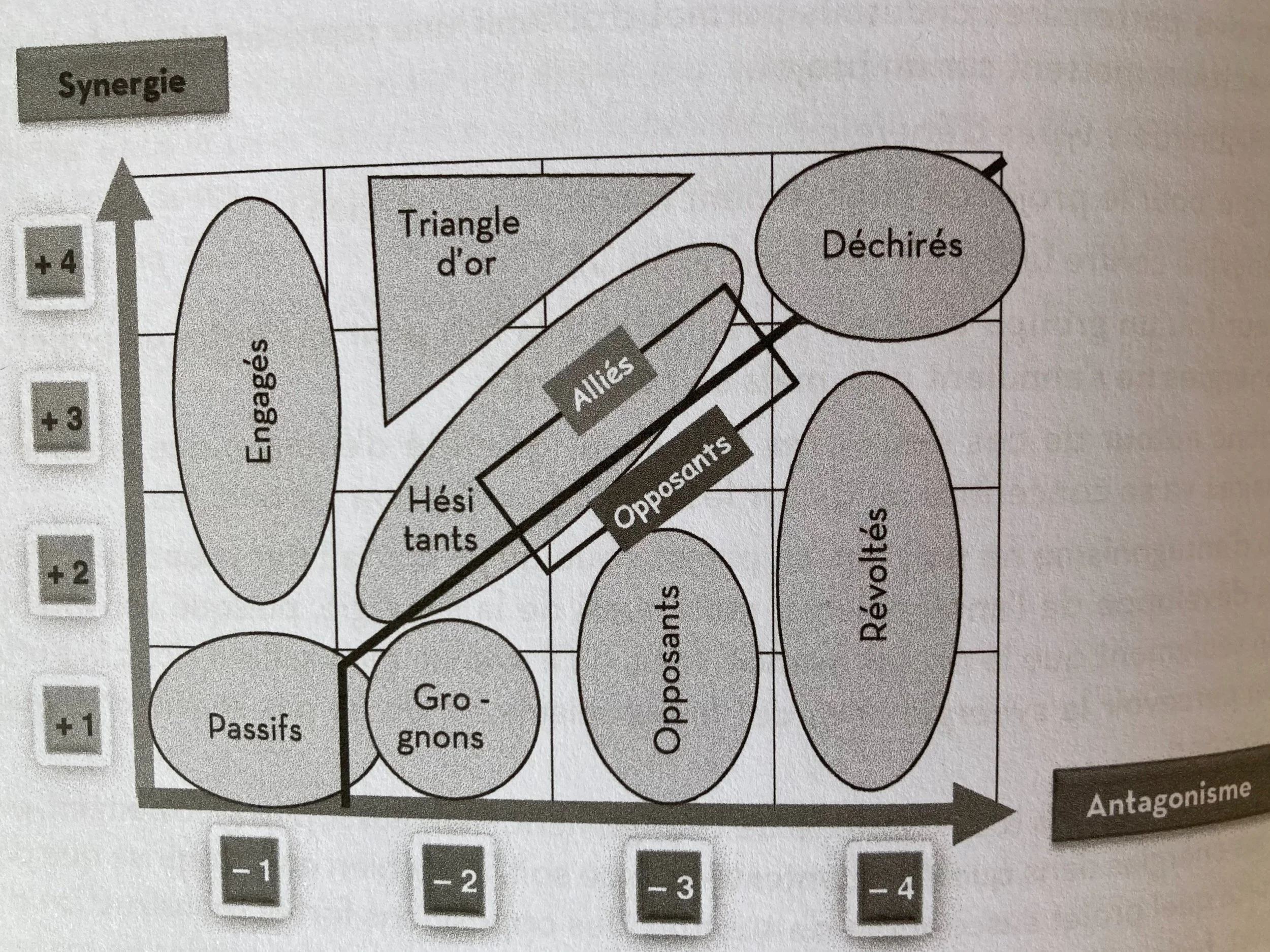
Sociodynamic Position of Stakeholders
Source: JC Faudet
🐝 YOUR CHALLENGE: SURROUND YOURSELF WITH THE RIGHT PEOPLE
If you're still with me (thank you, by the way), you're probably wondering, "OK, but in practical terms, what do I do?"
Here are two options:
You can take stock of the players around you and place them on the partners map above.
You can also answer these questions to identify your key allies based on your needs:
Who gives you positive energy?
Who can help you become more influential? Who can you talk to?
Who is a source of ideas? Who can share tools and feedback?
Who knows your ecosystem well and can help you navigate the political issues?
Who is motivated by and directly affected by your mission? With whom can you move forward and collaborate?
For each key need, you'll find the right ally. There's no need to ask your allies to be by your side 24 hours a day. They can be peers, superiors, mentors, colleagues, suppliers, customers, coaches, and friends.
MY FEEDBACK
I discovered the importance of allies during my coaching in Japan, thanks to Sophie Mauriac ( hello and thank you, Sophie, if you're reading this).
At the time, I felt very alone. My efforts to transform the organization, my position on the Executive Committee, the differences in Japanese culture, the managerial challenges, the environmental crisis—everything was weighing on me. I often complained. I felt like I was alone against everyone.
The process of identifying my allies helped me regain control of my daily life and my ability to make an impact. I had to open my eyes and figure out who could support me and provide me with resources based on my various needs and challenges.
A positive dynamic developed, and strong professional and personal bonds were formed. My daily life gradually changed, and a few years later I was able to leave Japan, proud of the collective impact we had made.
I can only advise you to stay focused and maintain your connections with your allies.
They're out there, just waiting for a sign from you. Believe me.
"So... ready to start?"
IF YOU FOUND THIS POST INSIGHTFUL, PLEASE LIKE IT AND SHARE IT WITH YOUR NETWORK. THAT'S THE BEST WAY TO SUPPORT ME.
Hi, Changemakers!
I am Nina, an impact maker coach specializing in leadership and sustainable transformation. For over 12 years, I have led sustainable change within a Fortune 500 organization in a multicultural environment. Through my work, I aim to inspire professionals in organizations to rethink business practices and help them take pride in contributing, in their own way, to a more sustainable, people-centered, and nature-friendly world. If you want to become an inspiring and impactful leader who engages your team and organization to create a better world, contact me!

Tool for 'changemakers': Win allies to maximize your impact!
I’m writing a series of articles about tools I’ve tested and found to be effective in my roles as a leader, change agent, mother, and entrepreneur. I promise they’re quick, simple, effective, and can lead to wonderful transformations—if you stick with them over time.
💡THE PROBLEM: “A LACK OF SUPPORT”
When you drive change—especially if it has a lasting impact or relates to corporate social responsibility—you often find yourself out of step with the rest of the group.
At best, we elicit surprise; at worst, we encounter suspicion or ridicule.
Changes aimed at promoting sustainability require collaboration with a wide range of stakeholders and organizational partners.
Nothing changes if you stay isolated.
The challenges are systemic—too vast to be tackled alone.
I regularly hear my clients complain about their loneliness, about how difficult it is to carry the burden alone, and about the frustration of constantly having to push others to take action.
I understand them.
I've been in their shoes.
But the real problem isn't the lack of commitment on the part of others.
The real challenge is twofold:
The engagement strategy is often inadequate.
The level of enthusiasm generated by our proposals and the way we embody change is often low.
Today I’m focusing on a key strategy to address the first point: engaging the right allies.
🔍 The Tool: The Allies' Strategy
"A project doesn't fail because of its opponents, but because of a cruel lack of allies."
This is one of the key lessons of sociodynamics, a method for managing change founded by Jean-Christian Fauvet in the 1970s.
What's important to understand is:
A person's stance toward your project depends on their feelings and opinions at any given moment. That stance may change over time.
Partnering with motivated individuals is essential to mobilizing a group. The goal, therefore, is not to convince those who are resistant or passive, but to capitalize on the drivers of change to create a ripple effect.
Here is the “partner map,” which is useful for mapping out your ecosystem and finding the right allies.
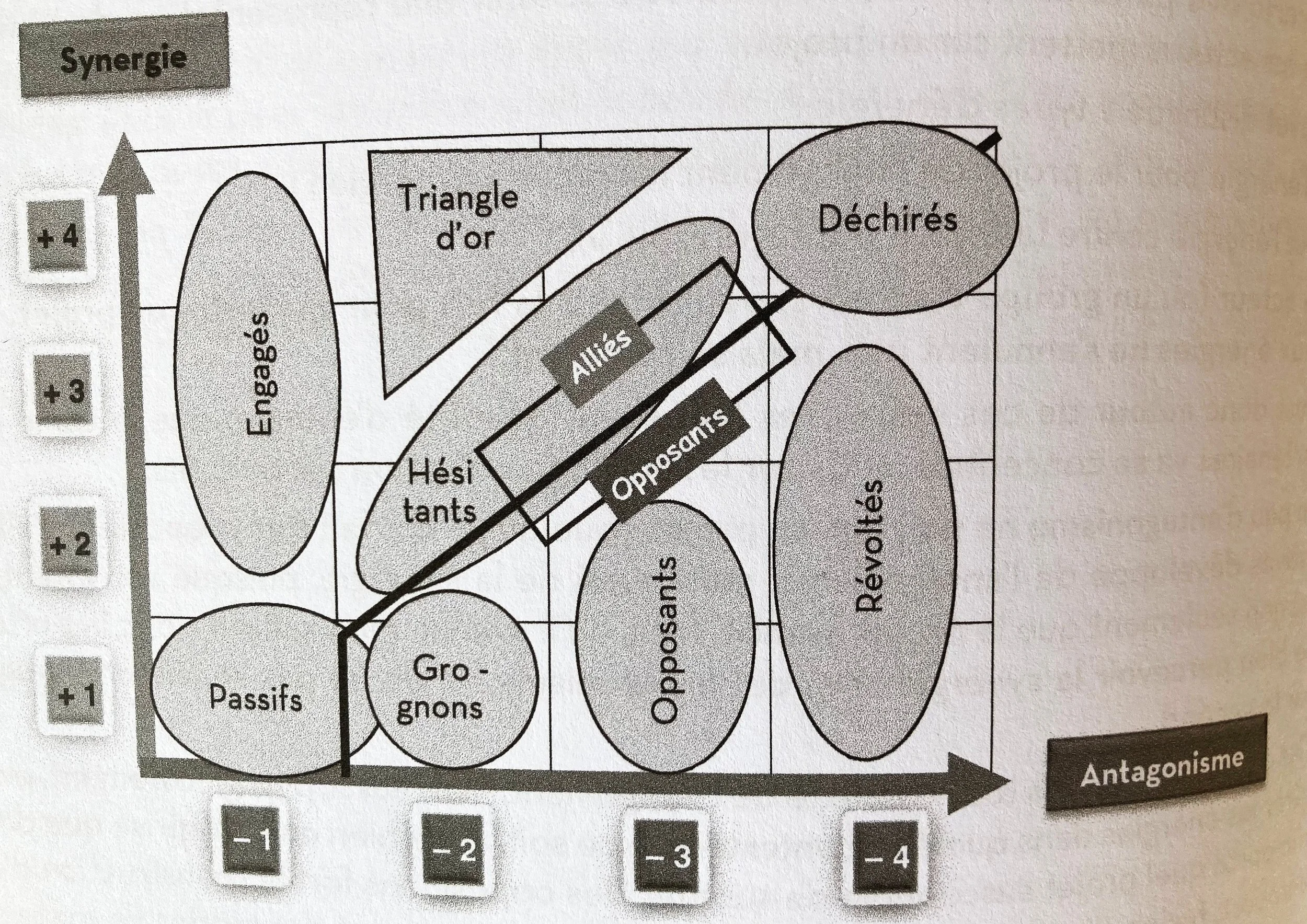
Sociodynamic Position of the Actors
Source: JC Faudet
🐝 YOUR CHALLENGE: SURROUNDING YOURSELF WITH THE RIGHT PEOPLE
If you're still with me (thanks, by the way), you're probably wondering, "OK, but in practical terms, what do I do?"
I'd like to offer you two options:
You can take stock of the people around you and place them on the partner map above.
You can also answer these questions to identify your key allies based on your needs:
Who gives you positive energy?
Who can help you gain more influence? Who can help you make your voice heard?
Who comes up with ideas? Who can share tools and feedback?
Who is familiar with your ecosystem and can help you navigate political issues?
Who is motivated by and directly involved in your mission? Who can you work with and collaborate with?
For every key need, you'll find the right ally. There's no need to expect your allies to be by your side 24 hours a day. They can be peers, supervisors, mentors, coworkers, suppliers, clients, coaches, and friends.
My Feedback
I discovered the importance of allies during my coaching in Japan, thanks to Sophie Mauriac ( hi, and thanks, Sophie, if you're reading this).
At the time, I felt very lonely. My organizational transformation projects, my position on the Executive Committee, the very different Japanese culture, the managerial challenges, the environmental crisis—it all weighed heavily on me. I often complained. I felt like I was alone against everyone.
The process of mapping out my allies helped me regain control of my daily life and my impact. I had to open my eyes and identify who could support me and provide me with resources tailored to my various needs and challenges.
A positive momentum followed, and strong professional and personal bonds developed. My daily life gradually changed, and a few years later, I was able to leave Japan, proud of the collective impact we had helped bring about.
I can only advise you to keep your eyes open and stay connected with your allies.
They're right there, just waiting for a sign from you. Trust me.
"So... Are you up for it or not?"
If you liked this post, please give it a "like" and share it with your network.
This is the best way to support me.
Hello to you, agents of change!
I’m Nina, an impact coach and committed board member, and an expert in leadership and sustainable transformation. I led transformation and sustainable development initiatives at Veolia for nearly 15 years, both in France and internationally. Today, what I love to do is help organizations and professionals rethink their business models and make them proud to contribute, in their own way, to a more sustainable, humane world that respects all life. If you want to be an inspiring leader and engage your team to maximize your impact, contact me!

A TOOL FOR CHANGEMAKERS: GREATER CLARITY FOR GREATER IMPACT!
I'm writing a series of articles about tools that I've tested myself as a leader, change-maker, mother, and entrepreneur. I promise they're quick, simple, and effective—and can even inspire beautiful transformations—if you commit to practicing them daily or as often as possible.
💡THE (REAL) PROBLEM WITH THE LACK OF CLARITY
Driving meaningful change is a complex challenge, especially for Léo, who is responsible for rolling out a tool to assess his company's carbon footprint.
He has to juggle several tasks:
Thinking about the technical and logistical aspects of the tool.
Familiarizing himself with similar standards and tools.
Organizing third-party certification.
Anticipating internal resistance, such as power struggles and cultural issues.
Refine its role and influence with stakeholders.
Under pressure, Léo is feeling alone and overwhelmed. His priorities are piling up, causing confusion and hindering his communication.
🔍 THE TOOL: WRITING
"WRITING IS THE BEST WAY TO FIND OUT WHAT YOU KNOW." - FLANNERY O'CONNOR
For Léo, rather than letting his thoughts go round and round in his head, writing is his best ally.
By putting his thoughts down on paper or on a screen, he can gain clarity on his thoughts and organize his tasks. This simple act brings him immense relief. In just a few moments, he can take a step back, discern what’s essential, and regain his inner calm. Writing is also a way for him to bring his mind, heart, and body together and to give free rein to his emotions.
By writing down the priorities, decisions, and questions discussed at meetings, he also establishes a pact with the people he is dealing with.
If you want to be as clear-headed as Leo, you can make writing a daily ritual. Write down your thoughts in the morning, record the decisions made in meetings, and reflect on the day in the evening. It's a way of life that keeps you clear-headed every day.
🐝 YOUR CHALLENGE TO CONSERVE YOUR ENERGY
Hopefully, if you're still reading this post (thanks, by the way), you're thinking something like, "OK, but what do I actually do?"
I suggest two things:
Every day, ideally in the morning, answer the following questions:
How do I feel?
What thoughts are on my mind this morning?
What are my top 3 priorities (both professional and personal) for the day so that I can make the impact I want?
Before an important meeting, clarify your strategy by asking yourself the following questions:
Why is this meeting important to me and my mission?
What do I want to accomplish by the time I leave?
What message do I want to convey?
MY EXPERIENCE
Writing was my lifeline.
In my role as Director of Sustainable Development and Corporate Purpose, the flood of thoughts could be overwhelming. To make sure I didn't lose track of anything along the way, I took notes and wrote things down. It was my way of staying on track and keeping projects moving forward.
Even today, it's my daily ritual to refocus my energies, clarify my thoughts, and calm my mind and heart.
You don't have to be a writer. Just let yourself be swept away by the power of writing.
"Writingis an act of creation, of letting your soul speak."
"So... ready to start writing?"
IF YOU FOUND THIS POST INSIGHTFUL, PLEASE LIKE IT AND SHARE IT WITH YOUR NETWORK. THAT'S THE BEST WAY TO SUPPORT ME.
Hi, Changemakers!
I am Nina, an impact maker coach specializing in leadership and sustainable transformation. For over 12 years, I have led sustainable change within a Fortune 500 organization in a multicultural environment. Through my work, I aim to inspire professionals in organizations to rethink business practices and help them take pride in contributing, in their own way, to a more sustainable, people-centered, and nature-friendly world. If you want to become an inspiring and impactful leader who engages your team and organization to create a better world, contact me!

Tool for "changemakers": Gain clarity to make a bigger impact!
I’m writing a series of articles about tools I’ve tested and found to be effective in my roles as a leader, change agent, mother, and entrepreneur. I promise they’re quick, simple, effective, and can lead to wonderful transformations—if you stick with them over time.
💡THE PROBLEM: “A LACK OF CLARITY”
Driving meaningful change is a complex challenge, especially for Léo, who is tasked with implementing a tool to assess his company's carbon footprint.
He has to juggle several tasks:
Consider the technical and logistical aspects of the tool.
Become familiar with similar standards and tools.
Arrange for third-party certification.
Anticipate internal resistance, such as political maneuvering and cultural issues.
Refine one's role and influence with stakeholders.
Under pressure, Léo feels alone and overwhelmed. His priorities become muddled, leading to confusion and hindering his ability to communicate.
🔍 The tool: WRITING
"Writing is the best way to discover what you know." – Flannery O’Connor
For Léo, rather than going around in circles in his head, writing is his best ally.
By putting his thoughts down on paper or on a screen, he clarifies his tasks, his questions, and his priorities. This simple act brings him immense relief. In just a few moments, he gains some perspective, identifies what’s essential, and regains his composure.
For him, writing is also a way to bring together his mind, heart, and body, and to give free rein to his emotions.
By writing down the priorities, decisions, and questions discussed in the meeting, he also establishes an agreement with the people he is meeting with.
If you want to be as clear-headed as Léo, you can make writing a daily ritual. Jot down your thoughts in the morning, document decisions during meetings, and reflect on the day in the evening. It’s a lifestyle habit that helps you stay clear-headed every day.
🐝 YOUR CHALLENGE TO BE MORE CLEAR AND INSPIRE OTHERS
Hopefully, if you’re still reading this post (thanks, by the way), you’re thinking something like, “Okay, but what do I actually do?”
I have two suggestions for you:
Every day—ideally in the morning—you can answer the following questions:
How do I feel?
What thoughts are on my mind this morning?
What are my top 3 priorities (both professional and personal) for the day to make the impact I want?
Before an important meeting, clarify your strategy by asking yourself the following questions:
Why is this meeting important to me / my mission?
What do I want to achieve by leaving?
What is the message we want to convey?
My Feedback
Writing was my lifeline. In my role as Director of Sustainability and Purpose, the flood of thoughts could be overwhelming. To make sure I didn’t lose track of anything, I took notes and wrote things down. It was my way of staying on course and moving projects forward.
Even today, this is my daily ritual for refocusing my energy, clarifying my thoughts, and calming my mind and heart. You don’t have to be a writer. You just have to let yourself be carried away by the power of writing.
"So... Are you up for it or not?"
“Writingis an act of creation; it’s letting your soul speak.”
If you liked this post, please give it a "like" and share it with your network.
This is the best way to support me.
Hello to you, agents of change!
I’m Nina, an impact coach and expert in leadership and sustainable transformation. I led transformation and multifaceted performance initiatives at Veolia for over 12 years. Today, what I love to do is help organizations and professionals rethink their business and make them proud to contribute, in their own way, to a more sustainable, humane, and nature-friendly world. If you want to be an inspiring leader and rally a team to maximize your impact, contact me!

TOOL FOR BECOMING A CHANGEMAKER - EP. 2
I'm writing a series of articles about tools that I've tested myself as a leader, change-maker, mother, and entrepreneur. I promise they're quick, simple, and effective—and can even inspire beautiful transformations—if you commit to practicing them daily or as often as possible.
💡THE (REAL) PROBLEM WITH LACK OF ENERGY
I don't know about you, but I'd love to feel like I'm at the top of my game all the time—optimistic and happy.
Not only is it a pleasant feeling, but above all, it allows me to be more agile and productive in my day-to-day work and, as a result, to have a greater impact in my work as a changemaker.
The reality is different.
I have moments when I feel low on energy and bouts of the blues.
Quite simply because life is 50-50.
There are pleasant and unpleasant emotions. Moments of wakefulness and moments of sleep, health and illness.
The real problem with a lack of energy is denying that there is a lack of energy.
In other words, the goal is to achieve a permanent state of full energy.
The solution, therefore, is to accept that energy is a series of ebbs and flows, and to “go with the flow.”
🔍 THE TOOL: THE NUMBER ONE REMEDY FOR LACK OF ENERGY
One way to encourage an abundant flow of energy within us is to activate ... the power of movement!
Let's shift our focus.
"Where your focus goes, your energy flows" - Tony Robbins
If you've learned to drive, you probably remember your driving instructor telling you to avoid looking at distractions on either side of you. Why would you do that? Because if you look at them, you might crash into them.
It's the same with your thoughts. If you focus on what's bothering you, you run the risk of dwelling on it and feeling a drop in energy. Conversely, if you focus on what brings you joy, chances are you'll feel full of energy.
And then, sometimes, the best thing to do is simply to accept things as they are.
Accept our low energy, sadness, and anger. And deal with it. Maybe it’s a sign to embrace that energy and go with the flow, take it easy, and take care of ourselves.
Reconnect with your body's powers.
In 2012, Harvard psychologist Amy Cuddy highlighted the connection between your body, your feelings, and the impact you have on others. In her TED Talk, she explains how body language affects the way others perceive us and our self-confidence.
Power poses (such as holding your head up, standing straight, and keeping your arms open) can "alter testosterone and cortisol levels in the brain and may even affect our chances of success."
Honor Life
What I'm telling you may seem insignificant or unrelated to your goals as a leader of desire. But it's quite the opposite. By choosing to bring movement back into your body, you honor the power of life within you.
Your blood flows. Your breath comes and goes. Your heart beats. Everything is in motion. It's a sign of life.
So why choose to be in a state without any fluctuation? Why choose to be static?
If we truly want to bring about systemic change that will enable us to live in harmony with our home on Earth, it seems to me essential to embody this change.
To inspire others to change, let's dance to the rhythm of the life within us!
🐝 YOUR CHALLENGE TO CONSERVE YOUR ENERGY
Hopefully, if you're still reading this post (thanks, by the way), you're thinking something like, "OK, but what do I actually do?"
I suggest two things:
Every day—ideally in the morning—get your body moving.
The idea is to reconnect with your body and find your center. This could be yoga, walking, swimming, dancing to a song you like, cardio, or Qi Gong.
The important thing is to keep moving for 5–10 or even 30 minutes to wake yourself up and get your positive energy flowing.
When you're feeling low on energy or irritable, get moving.
If you receive an exasperating email or find yourself in the middle of a heated discussion, I recommend that you walk around a bit and—ideally—leave the space where you felt the tension.
Even if it's just for a few minutes, moving around will help you create some distance from the problem and get your energy flowing.
Chances are you'll calm down and maybe come up with some ideas or solutions along the way.
MY EXPERIENCE
When I was Director of Sustainable Development and Purpose, I often had to switch from one topic to another. I had to deal with a lot of resistance and complexity. I would feel tense and tired. At times like that, conversations could easily go off the rails if I didn't strike the right tone or maintain the right mindset.
When I began to harness the power of movement, I was able to form a partnership with my body and, as a result, gain a new perspective. It helped me maximize both my energy and my impact. It's a journey, but it's worth it.
Even today, I often use the power of the body and mindfulness to help my clients—whom I coach—overcome obstacles or a loss of motivation. This process is very powerful.
"So... ready to get up and start moving?"
IF YOU FOUND THIS POST INSIGHTFUL, PLEASE LIKE IT AND SHARE IT WITH YOUR NETWORK. THAT'S THE BEST WAY TO SUPPORT ME.
Hi, Changemakers!
I am Nina, an impact maker coach who specializes in leadership and sustainable transformation.
I have spent the past 12+ years leading sustainable change at a Fortune 500 company in a multicultural environment. Through my work, I aim to inspire professionals in organizations to rethink business and make them proud to contribute, in their own way, to a more sustainable, humane, and nature-friendly world. If you want to be an inspiring and influential leader who engages your team and organization to create a better world, contact me!

A Tool for Shining as a 'Changemaker' - Ep. 2
I’m writing a series of articles about tools I’ve tested and found to be effective in my roles as a leader, change agent, mother, and entrepreneur. I promise they’re quick, simple, effective, and can lead to wonderful transformations—if you stick with them over time.
💡THE PROBLEM: “LACK OF ENERGY”
I don't know about you, but I'd love to feel like I'm at my best, optimistic, and happy all the time.
Not only is it a pleasant feeling, but above all, it allows me to be more agile and productive in my daily life and, as a result, to have a greater impact in my work as an agent of change.
The reality is different.
I have times when my energy drops and I feel down.
Quite simply because life is 50-50.
There are pleasant emotions and unpleasant ones. There are moments of wakefulness and moments of sleep, health and illness.
The real problem isn't a lack of energy; it's refusing to acknowledge that lack of energy.
Or to put it another way, the problem is trying to achieve a permanent state of high energy.
The solution is to accept that energy consists of a series of ebbs and flows. The key is to go with the flow (“follow the flow”).
🔍 The Tool: The #1 Remedy for Low ENERGY
To promote a plentiful flow of energy within us, all we need to do is activate … the power of movement!
Shift one's focus.
“Where your focus goes, your energy flows”— Tony Robbins
If you've learned to drive, you probably remember your driving instructor telling you to avoid looking at the wall or the cars on your right. Why? Because if you looked at them, you might run into them!
It's the same with your thoughts.
If you focus on what upsets you, you risk dwelling on it and feeling a drop in energy. On the other hand, if you focus on what brings you joy, there’s a good chance you’ll feel full of energy.
And then, sometimes, the best thing to do is simply to accept it.
Accept your low energy, your sadness, your anger. And learn to live with them. Team up with that energy to take it easy. To take care of yourself.
Reconnect with the body's natural powers.
In 2012, Amy Cuddy, a Harvard psychologist, highlighted the connection between the body, our feelings, and the impression we make on others. In her TED talk, she explains how body language affects our self-confidence and the way others see us.
“Power poses (i.e., poses such as holding your head high, standing up straight, keeping your arms open, and planting your feet firmly on the ground) can ‘alter testosterone and cortisol levels in the brain and may even affect our chances of success.’”
Honoring Life
What I'm telling you may seem trivial or unrelated to your goals as an inspiring leader.
But it's actually the exact opposite.
By choosing to bring movement back into your body, you honor the power of life within you.
Your blood is flowing. Your breath comes and goes. Your heart is beating. Everything is in motion. It’s a sign of life.
So why would anyone want to be in a state without fluctuations?
If we want to drive systemic changes that will allow us to live once again in harmony with our home, Earth, I believe it is essential that we embody that change.
To inspire others to change, let’s dance to the rhythm of life within us!
🐝 YOUR CHALLENGE to preserve your ENERGY
Hopefully, if you’re still reading this post (thanks, by the way), you’re thinking something like, “Okay, but what do I actually do?”
I have two suggestions for you:
Every day—ideally in the morning—get your body moving again
The idea is to reconnect with your body and find your center.
It could be yoga, a walk, dancing to a song you love, cardio, or Qi Gong. The important thing is that you stay active for 5–10 or 30 minutes to wake yourself up and get that positive energy flowing.
When you're feeling low on energy, get moving.
If you receive an annoying email or have just come out of a heated discussion, I recommend taking a short walk and—ideally—leaving the space where you felt the tension. Even if it’s just for a few minutes, it will help.
This movement will help you create some distance and allow energy to flow within you. There’s a good chance that calm will return and that ideas or solutions will emerge along the way.
My Feedback
When I was Director of Sustainability and Purpose, I was often running all over the place, jumping from one issue to another. I faced a lot of resistance and complexity. Sometimes I would feel stressed and tired.
At times like those, conversations could easily get out of hand if I didn't have the right tone of voice or the right frame of mind.
When I began to harness the power of movement, I was able to form a partnership with my body and, as a result, rise above the rest. This allowed me to maximize my impact and energy. It’s a journey—it requires being intentional every day—but it’s worth it.
Even today, I often use the power of the body and mindfulness to help my clients overcome roadblocks or a loss of motivation. This process is very powerful.
So... Can you get up and start moving?
"Dareor No Dare?"
If you liked this post, please give it a "like" and share it with your network.
This is the best way to support me.
Hello to you, agents of change!
I'm Nina Cambadélis, an impact coach and expert in leadership and sustainable transformation.
I was in charge of transformation and multifaceted performance initiatives at Veolia for more than 12 years.
Today, what I love to do is help organizations and professionals rethink their business models and make them proud to contribute, in their own way, to a more sustainable, humane, and nature-friendly world. If you want to be an inspiring leader and rally a team to maximize your impact, contact me!

TOOLS FOR BEING A CHANGEMAKER—EP. 1
I'm writing a series of articles about tools that I've tested myself as a leader, change-maker, mother, and entrepreneur. I promise they're quick, simple, and effective—and can even inspire beautiful transformations—if you commit to practicing them daily or as often as possible.
💡THE (REAL) PROBLEM OF NOT HAVING ENOUGH TIME
As a changemaker, I bet your life feels like a never-ending race against the clock.
Finding time to:
stay up to date on sustainability-related news, issues, and solutions,
Respond to emails and assist support teams.
Add value by offering innovative and sustainable solutions, even if your colleagues contact you at the last minute.
Support operational staff who are working hard to change the way they produce and consume.
Offer your teams a sympathetic and encouraging ear.
Respond quickly and effectively to your boss.
Take the time to propose a vision that's a little more ambitious than the current one.
Manage all aspects of your personal life: the kids' doctor's appointments, the household items you need to buy, your next dinner with friends, and replying to Mom's text messages.
And that's not even counting the sport you'd like to squeeze in somewhere or the book that's been sitting in your bag for weeks.
You're probably getting dizzy just reading this, aren't you?
But doesn't that sound a bit like your everyday life?
So here goes—wait a minute—the real problem isn't a lack of time.
I SWEAR.
I, too, would have preferred to complain about the lack of time.
The real problem is the constant rush.
Not having a minute to yourself.
It's that inner thought that says, "It's never enough."
The desire for “more and more.”
That's right.
By trying to save time so we can do everything right, you and I end up like hamsters on a wheel.
It's a twofold problem:
This pace wears us out and leads to an explosion or an implosion.
This pace drives away the people around us who might want to get involved.
🔍 THE TOOL: THE NUMBER ONE SOLUTION TO A LACK OF TIME
So what's the solution?
It's quite simple. Yet it's often overlooked.
It's ...
THE BREAK.
I can already hear you screaming, "Is she serious? I don't have time, and she wants me to take a break!"
I know. It's hard.
But honestly, have you ever tried to stay loving, cheerful, smart, efficient, and generous without sleeping for several nights in a row?
If you've had children, you know what I mean.
If you've ever had trouble sleeping, you know what I mean, too.
Personally, I've had both :)
So I know it in my heart, and you know it in yours...
To stay in shape, we need to sleep.
To make an impact and have enough time, we need to take a break.
Period.
And the same is true for society.
If we want to limit global warming and prevent famine and mass migration, we urgently need to slow down.
It's difficult, but essential.
Change is essential if we want to live in a world where life reigns supreme.
And change begins within ourselves ...
🐝 YOUR CHALLENGE TO DO MORE AND BETTER OVER TIME
Hopefully, if you're still reading this post (thanks, by the way), you're thinking something like, "Okay, but how do I do it?"
I suggest you take 10 minutes for yourself every day.
In the morning (ideally), at lunchtime, or in the evening.
10 minutes just for you.
A time WITHOUT screens, without washing the dishes, without going over the to-do list.
A time when you can do what makes you happy:
Breathe (cardiac coherence)
Lie down
Write
Read
Draw
Walk
Dance to music you like
MY EXPERIENCE
During what felt like my 10,000-hour days, the best way to regain clarity and energy was to lie down (or sit down if I was at the office) after lunch, set an alarm, close my eyes, and breathe—focusing on my breath or even letting myself doze off.
And I promise you—take it from a demanding multitasker—it works.
I started working in Japan over 6 years ago.
At the time, I was going through a very challenging period in my life in many ways.
This ritual served as the gateway to bringing about effective changes with far-reaching consequences.
So yes, taking care of yourself is THE best way to take care of others and the world.
And frankly, 10 minutes out of 24 hours—it's possible. Even if it means getting up 10 minutes earlier!
After taking a course that addressed this issue, I recently realized that this tool had become a habit. I still have a long way to go, and I often find myself falling into the trap of trying to optimize my time and making long to-do lists. But I’m making progress.
So thank you to Hélène Bonhomme for this valuable reminder and for sharing! And congratulations on your inspiring work!
"So... will you accept the dare?"
IF YOU FOUND THIS POST INSIGHTFUL, PLEASE LIKE IT AND SHARE IT WITH YOUR NETWORK. THAT'S THE BEST WAY TO SUPPORT ME.
Hello to you, agents of change!
Hi, Changemakers!
I am Nina, an impact maker coach who specializes in leadership and sustainable transformation.
I have spent the past 10+ years leading sustainable change at a Fortune 500 company in a multicultural environment. Through my work, I aim to inspire professionals in organizations to rethink business and make them proud to contribute, in their own way, to a more sustainable, humane, and nature-friendly world. If you’d like support to advance on your journey with greater impact and ease, contact me!

A Tool for Shining as Agents of Change - Ep. 1
I’m writing a series of articles about tools I’ve tested and found effective as a leader, change agent, mother, and entrepreneur. I promise they’re quick, simple, and effective—and can even lead to meaningful transformations—if you commit to using them over time.
💡The (REAL) PROBLEM WITH A LACK OF TIME
As an agent of change, I bet your life feels like a never-ending race against the clock. Finding time to:
Learn about the latest news, issues, and solutions.
Responding to emails, supporting this or that team.
Add value by providing innovative and sustainable solutions, even if your colleagues contact you at the last minute.
Support frontline workers who are racking their brains to change the way they produce and consume.
Offer your teams a supportive and encouraging listening ear.
Respond to your boss quickly and effectively.
Take the time to present him with a vision that is a little more ambitious than the one currently in place.
And then there's managing your whole personal life: the kids' doctor's appointments, restocking household supplies, the next dinner with friends, and replying to Mom's text message.
And that's not even counting the workout you'd like to squeeze in somewhere or the book that's been waiting for you in your bag for weeks.
Just reading this must be making your head spin, right?
Still, doesn't that sound a bit like your everyday life?
So here's the thing—hang in there—the real problem isn't a lack of time.
I SWEAR.
I, too, would have preferred to complain about the lack of time.
The real problem is running without stopping.
Not having a single minute to yourself.
It is the imperative of “never enough.”
The "always more."
That's right.
In our efforts to save time so we can do everything right, both you and I end up running like hamsters on a wheel.
This is a twofold problem:
This pace is exhausting and is pushing us to the breaking point.
This pace drives away the people around us who might want to get involved.
🔍 The tool: the number one solution to a lack of time
So what's the solution?
It's very simple. Yet it's often overlooked.
It's …
THE BREAK.
I can already picture you yelling, “Is she kidding me?? I don’t have time, and she wants me to take a break?!”
I know. It's hard.
But honestly, have you ever tried to hold it together and remain a loving, cheerful, intelligent, efficient, and generous person without sleeping for several nights in a row?
If you've had kids, you know what I'm talking about.
If you've ever had bouts of insomnia, you know exactly what I'm talking about.
Personally, I've had both :)
So I know it deep down, and you know it deep down …
To stay healthy, we need to sleep.
To make an impact and have time, we need to take a break.
That's all there is to it.
And the same goes for society.
If we want to limit global warming and prevent famines and mass migration, we urgently need to slow down.
It's difficult, but essential.
Change is essential if we want to live in a world where life reigns supreme.
And change starts with oneself …
🐝 YOUR CHALLENGE TO DO MORE AND BETTER OVER TIME
Hopefully, if you’re still reading this post (thanks, and kudos to you, by the way), you’re thinking something like, “Okay, but how do I do that?”
I suggest you take 10 minutes for yourself every day.
Whether it's in the morning (ideally), at lunchtime, or in the evening.
10 minutes just for you.
So, for a while: NO screens, no dishes to put away, no mulling over the to-do list.
A time when you can do whatever brings you joy:
Breathing (cardiac coherence)
Lie down
Write
Read
Draw
Walking
Dance (even just in your head) to music you love
My Feedback
To start with, during my hectic days, the best way to regain clarity and energy was to lie down (or sit down if I was at the office) after lunch, set an alarm, close my eyes, and breathe while focusing on my breath—or even let myself doze off.
And I promise you—take it from a demanding multitasker—it works.
I started out in Japan more than 6 years ago.
At the time, I was going through a very challenging period in my life in many ways.
This ritual opened the door to wonderful changes and had a multiplied impact.
So yes, taking care of ourselves is THE best way to take care of others and the world.
And honestly, 10 MIN out of 24 H can be optimized. Even if it means getting up 10 MIN earlier!
While following a program that addressed this issue, I realized that “taking a break”—even a quick one—had become second nature. It’s one of my daily rituals! I still have a long way to go, and I often find myself falling back into the trap of trying to optimize my time and creating endless to-do lists. But I’m making progress.
So thank you to Hélène Bonhomme for this valuable reminder, which inspired me to write this article. Congratulations on your inspiring impact.
"So... Are you up for it or not?"
If you liked this post, please give it a "like" and share it with your network.
This is the best way to support me.
Hello to you, agents of change!
I'm Nina Cambadélis, an impact coach and expert in leadership and sustainable transformation.
For more than 10 years, I was in charge of transformation and multifaceted performance initiatives at a multicultural CAC 40 company. What I love to do is help organizations and professionals rethink their business and make them proud to contribute, in their own way, to a more sustainable, humane, and nature-friendly world. If you’d like some guidance on your journey, contact me!

Principle 12, derived from permaculture, to guide your mission of transformation
" Use and make the most of renewable services and resources”
I am writing a series on the parallels between the principles of permaculture and change within organizations to help change agents create sustainable transformations.
💡 A Simple Explanation of the Principles of Permaculture
Permaculture is an agricultural method that aims to integrate human activity into the natural environment in order to create highly efficient, self-sustaining ecosystems.
The permaculture principle we're going to explore today is fairly simple to apply but is often overlooked. We are encouraged to "use renewable resources."
Renewable resources are those that can be replaced and replenished, taking into account the time required for their production.
Let's take an example from everyday life: your energy level. Chances are you'll often feel full of energy if you:
Listen to your body and mind.
Rest when you feel tired.
Get enough sleep.
Meeting inspiring people.
Spend time doing things you enjoy.
On the other hand, you might end up exhausted—or even break down—if you do the exact opposite for a longer or shorter period of time.
This permaculture principle also encourages us to make the most of what’s here and now. In organizations, this means your time, your current projects, your ideas—and even those of your colleagues and partners.
🔍 Applying the Principle in a Transformation Initiative
Let's consider a key factor in the success of change agents within organizations: support from top management.
Applying this permaculture principle means avoiding the need to seek approval from every decision-maker within your organization before launching your project. You can still be credible and make a positive impact by launching a pilot project with a committed and enthusiastic sponsor.
When I started working at Veolia Asia more than 10 years ago, I conducted sustainability assessments at our operational sites. This approach was not only a good way to connect with the field and understand their challenges, but also to get a 360-degree snapshot of the site’s operations and overall performance.
I noticed that the operators were very happy because:
They felt recognized and supported.
They had facts and information to highlight the positive impact of their work to clients and members of the local community.
They quickly identified priorities for action to improve performance and cross-functional projects that were often overlooked.
This type of assignment helped bridge the gap between the "field" and "headquarters" in a positive way. It was the people in the field who communicated their needs to headquarters, not the other way around.
Despite this positive feedback, I had a hard time getting approval from the unit directors to conduct these evaluations.
One day, during a seminar, a manager—whom I’ll call John—told me, “Stop asking them. Come work in my area. You already have more than thirty locations open to you. The rest will follow.”
You know what? He was right. Within a few years, his organization’s success stories led other organizations and countries to implement sustainability assessments.
🐝 Tips for Getting Active
I suggest you look around and identify:
Three people who can support you in your endeavors (for example, mentors, a coach, a dedicated sponsor, inspiring peers, or a friend who listens to you).
Three activities that give you the energy you need to keep moving forward (for example, here are mine: yoga, walks in nature, spending time with my daughter, and music).
Three projects that could create a ripple effect and inspire others to get involved in the movement you’re launching (for example, the “human factor” mural, assessing the carbon footprint of business solutions, and revising employee bonus systems to take into account their social, societal, and environmental actions).
So, do you realize how much abundance surrounds you? One step at a time. I trust you to move forward in the direction you want. If you need to move faster or more efficiently, please feel free to contact me.
As we conclude this series of articles exploring the parallels between permaculture and organizational transformation, I would like to acknowledge and thank two authors and books that have been a source of inspiration:
"Everything Goes in Circles on This Earth, and We're the Only Ones Who Don't Know It " by Marine Simon
Solène Pignet's Guide to Sustainable Entrepreneurship.
I recommend that you read these books if you want to learn more about permaculture and how it applies to everyday life.
"Aman is not unhappy because he has ambition, but because he is consumed by it."
If you liked this post, please show your support by liking it and sharing it with your network. That's the best way to support me.
Hello to you, agents of change!
I'm Nina Cambadélis, an impact coach and expert in leadership and sustainable transformation.
For more than 10 years, I was in charge of transformation and multifaceted performance initiatives at a multicultural CAC 40 company. What I love to do is help organizations and professionals rethink their business and make them proud to contribute, in their own way, to a more sustainable, humane, and nature-friendly world. If you’d like some guidance on your journey, contact me!

12th Permaculture-inspired tip to help you carry out your mission of transformation
“Using and adding value to renewable services and resources”
I am writing a series on the parallels between the twelve operational principles of permaculture and organizational change, with the aim of supporting changemakers in creating sustainable transformations.
💡 EXPLAINING THE PERMACULTURE PRINCIPLE
Permaculture is an agricultural method that seeks to integrate human activity with the natural environment in order to create highly efficient, self-sustaining ecosystems.
The permaculture principle we’ll explore today is quite simple to apply but is often overlooked.
We are encouraged to “use renewable resources.”
Renewable resources are those that can be replenished and renewed, taking into account the time required to produce them.
Let's take an example from everyday life: your energy levels. Chances are you'll often feel full of energy if you:
Listen to your body and mind.
Rest when you feel tired.
Get enough sleep.
Meet inspiring people.
Spend time doing things you enjoy.
On the other hand, you may become exhausted and even collapse if you do the opposite.
This permaculture principle also encourages us to make the most of what is available right here and now. In organizations, this means your time, current projects, ideas, and even those of your colleagues and partners.
🔍 ILLUSTRATING THE PERMACULTURE PRINCIPLE AS APPLIED TO A MISSION OF TRANSFORMATION
Let's take a look at a key resource for the success of change agents within organizations: the support of top management.
Applying this permaculture principle means not seeking approval from all the leaders of the various units within your organization before launching your project. You can establish credibility and make a positive impact by starting with a pilot project that has just one genuinely committed sponsor.
When I started working at Veolia Asia more than 10 years ago, I was conducting sustainable development assessments at our operational sites.
This approach was not only a good way to connect with the field and understand their challenges, but also to obtain a 360° snapshot of the site's operations and overall performance.
I could tell that the operators were very happy because:
They felt recognized and supported.
Site members and managers had facts and insights to highlight the positive impact of their work on customers and members of the local community.
They were able to quickly identify the key areas for improvement and the cross-functional projects that were often overlooked.
This type of mission successfully bridged the gap between the “field” and “headquarters.” Field employees identified where headquarters staff were needed, not the other way around.
However, I had a hard time getting the entity's directors to agree to these assessments.
One day during a seminar, a director—whom I’ll call John—said to me, “Stop asking them. Come work for me. You already have more than thirty sites available to you. The rest will follow.”
You know what? He was right. In just a few years, his organization’s success stories led other organizations and countries to implement sustainable development assessments.
🐝 TIPS TO GET MOVING
Look around and identify:
Three resource persons to support you in your missions and challenges (e.g., mentors, a coach, a dedicated sponsor, inspiring peers, a friend who listens to you, and a newsletter author).
Three activities that give you the energy you need to keep going (for example, mine are yoga, nature walks, spending time with my daughter, and music).
Three projects that could create a ripple effect and inspire others to get involved in the movement you are launching (e.g., a “human factor” mural, an assessment of the carbon footprints of business solutions, and a review of employee bonus schemes that take into account their social, societal, and environmental actions).
So, do you see the abundance all around you? Take it one step at a time. I’m confident you’ll move in the direction you want. If you need to move faster or more efficiently, please feel free to reach out to me—I’d be happy to listen.
As we come to the end of this series of articles exploring the parallels between permaculture and organizational transformation, I’d like to acknowledge and thank two authors who inspired me throughout this process:
“Everything on This Earth Goes Round and Round, We're the Only Ones Who Don't Know It”by Marine Simon
“The Sustainable Entrepreneur's Guide” by Solène Pignet.
I recommend reading their books if you want to explore permaculture topics in greater depth.
“Aman is unhappy not because he has ambition, but because he is consumed by it.”
IF YOU FOUND THIS POST INSIGHTFUL, PLEASE LIKE IT AND SHARE IT WITH YOUR NETWORK. IT'S THE BEST WAY TO SUPPORT ME.
Here are the previous articles in this series: the first post, the second one, the third one, the 4th one, the 5th one, the 6th one, 7th one, 8th one, 9th one, 10th one, the 11th one.
Hi, Changemakers!
I am Nina, an impact maker coach who specializes in leadership and sustainable transformation.
I have spent the past 10+ years leading sustainable change at a Fortune 500 company in a multicultural environment. Through my work, I aim to inspire professionals in organizations to rethink business and make them proud to contribute, in their own way, to a more sustainable, humane, and nature-friendly world. If you’d like support to advance on your journey with greater impact and ease, contact me!

11th Permaculture-inspired tip to help you carry out your mission of transformation
“PRODUCE NO WASTE”
💡 EXPLAINING THE PERMACULTURE PRINCIPLE
Nature teaches us that “everything one person throws away is food for another (...) the earthworm is a symbol of this principle, because it feeds on plant litter (i.e., waste) and converts it into humus. This humus improves the structure of the soil, and the worm, as well as the soil microorganisms and plants, benefit from this improvement.”
Marine Simon, *Everything Is Going Round and Round on This Earth, We Are the Only Ones Who Don't Know It*, page 182
Permaculture, an agricultural method that seeks to integrate human activity with the natural environment in order to create highly efficient, self-sustaining ecosystems, embraces the principle of zero waste. One example is the use of animal manure to fertilize the soil.
But it goes beyond permaculture. In our society, we have also established the 5 Rs (Refuse, Reduce, Reuse, Repair, and Recycle) based on the goal of zero waste.
🔍 ILLUSTRATING THE PERMACULTURE PRINCIPLE AS APPLIED TO A MISSION OF TRANSFORMATION
This permaculture principle is also underscored by Antoine Lavoisier’s famous quote: “Nothing is lost, nothing is created; everything is transformed.” This mantra can be very beneficial for changemakers, helping them save time while maximizing their positive impact on nature and society.
Let me give you an example of how to apply Antoine Lavoisier’s wisdom.
When I took over the Asia Sustainability Department at Veolia, the leader in environmental services, in 2012, I discovered a unique manual developed by two remarkable women who had previously headed that department.
This manual, intended for operational staff in the field, demystified the concept of sustainability by proposing very concrete actions that could be implemented to move toward a multifaceted approach to organizational performance.
Among other topics, it explained how to calculate a carbon footprint, how to protect natural species, how to reuse wastewater, how to promote diversity, and how to build partnerships with schools. Essentially, it outlined key strategies for operators to make a positive impact on the company, its customers, and the local community.
Over time, some of the information and tools in the manual became outdated, while other content had already been widely adopted. New needs arose, and operators and managers began requesting new formats.
Our team wanted to honor the expertise shared by this valuable resource while adapting to new expectations.
Recognizing the need for new ways to strengthen our company’s positive impact on nature, society, and customers, we organized a collective intelligence workshop with representatives from operations, sales, marketing, human resources, purchasing, and health and safety. We also explored their constraints and expectations regarding support, tone, workload, and other factors.
Based on these discussions, we launched three tools for our employees in Asia:
A podcast that highlights the people behind their roles—their ambitions, struggles, successes, and real-life case studies—to inspire employees to become changemakers.
A fun online course consisting of very short, practical videos and quizzes designed to familiarize all players—especially those working in the field—with sustainability issues that may be perceived as too abstract.
A toolkit for understanding internal know-how and its benefits. The challenge was to provide salespeople with the language they needed, while also guiding employees in replicating and adapting these initiatives to their own context.
Here is how one tool gave rise to three tools, and how the relationship with the field was strengthened through working as co-creators.
🐝 TIPS TO GET MOVING
Sustainability project leaders put a lot of effort and hard work into their work.
Sometimes the professionalism and quality of their work do not seem to generate the response they expect and deserve.
If this applies to you, here are a few ways to breathe new life into your work:
Review all the material created over the past 3–5 years: Are there any nuggets of wisdom to share? How can you quickly and easily breathe new life into these initiatives?
Identify successful and impactful partnerships from the past 3–5 years: How can you measure the positive impacts to develop case studies and business references? How can you identify simple methods to inspire others?
Listen to your ecosystem: What challenges are they facing in terms of sustainable development? What do they need? In what form? How can you repurpose and enhance existing materials to support them?
“Producingno waste invites us to become more aware of the responsibility for our actions and the traces (dirt?) they leavebehind”
IF YOU FOUND THIS POST INSIGHTFUL, PLEASE LIKE IT AND SHARE IT WITH MEMBERS OF YOUR NETWORK WHO MIGHT BENEFIT FROM IT.
IT'S THE BEST WAY TO SUPPORT ME.
As a reminder, I am writing a series on the parallels between the 12 operational principles of permaculture and the conditions for sustainable transformations of organizational systems. Here is the first post, the second one, the third one, the 4th one, the 5th one, the 6th one, 7th one, 8th one, 9th one, and 10th one.
If you are a professional changemaker committed to promoting a better society, these principles and insights should help you maximize your impact and inner serenity.
Hello, Changemakers!
I am Nina, an impact maker coach who specializes in leadership and sustainable transformation.
I have spent the past 10+ years leading sustainable change at a Fortune 500 company in a multicultural environment. Through my work, I aim to inspire professionals in organizations to rethink business and make them proud to contribute, in their own way, to a more sustainable, humane, and nature-friendly world.
If you'd like support to move forward on your journey with greater impact and ease, contact me!

Principle 11, derived from permaculture, to guide your mission of transformation
" Zero Waste ”
💡 A Simple Explanation of the Principles of Permaculture
Nature teaches us that “what some beings discard serves as food for others. (...) The earthworm is a symbol of this principle, because it feeds on plant debris (i.e., waste), which it converts into humus. This humus improves soil structure, and the earthworm, along with soil microorganisms and plants, benefits from this improvement.”
Marine Simon, *Everything Goes in Circles on This Earth; We're the Only Ones Who Don't Know It*, p. 182.
Permaculture, an agricultural method that seeks to integrate human activity into the natural environment in order to create highly efficient, self-sustaining ecosystems, embraces the principle of zero waste. The use of animal manure to fertilize the soil is one example of this.
But it goes beyond permaculture. In our society, we have also established the 5 Rs (Refuse, Reduce, Reuse, Repair, and Recycle) to move toward the goal of zero waste.
🔍 Applying the Principle in a Transformation Initiative
This principle of permaculture is also highlighted by Antoine Lavoisier’s famous quote: “Nothing is lost, nothing is created; everything is transformed.” This mantra can be very useful for change agents. Applying it saves time while maximizing one’s positive impact.
Let me give you an example of how Antoine Lavoisier's wisdom can be applied.
When I took over as head of sustainable development at Veolia Asia—the leader in environmental services—in 2012, I discovered a very practical handbook put together by two remarkable women who had previously led that department.
This tool, designed for frontline staff, demystified the concept of sustainability by proposing very concrete actions to help the organization achieve well-rounded performance.
Among other things, he explained how to calculate a carbon footprint, how to protect native species, how to reuse wastewater, how to promote diversity within a team, and how to establish partnerships with schools. Essentially, he shared key strategies that enable operators to have a positive impact on their company, their customers, and the local community.
Over time, the teams adopted many principles, and some information became outdated. New needs arose, and operators and managers requested new formats.
Our team wanted to honor the expertise embodied in this valuable resource while adapting to new expectations.
Recognizing the need to find new ways to enhance our company’s positive impact on the environment, society, employees, and customers, we created a collective intelligence workshop bringing together representatives from operations, sales, marketing, human resources, procurement, and health and safety. We also explored their constraints and expectations regarding support, tone, bandwidth, and so on.
Based on these discussions, we launched three tools for our employees in Asia:
A podcast that highlights people in their roles, their ambitions, their challenges, their successes, and real-life examples, inspiring other employees to become agents of change.
A fun online course consisting of very short, practical videos and quizzes designed to familiarize all employees—especially those in the field—with new sustainability issues that may seem too abstract.
A toolkit that explains the company’s internal expertise and its benefits. The goal was to provide sales representatives with talking points, but also to guide employees so they could replicate and adapt these initiatives to their own context.
Here’s how one tool gave rise to three tools, and how the connection with the field was strengthened through a collaborative effort
🐝 Tips for Getting Active
Project managers working in the field of sustainable development put a lot of effort and hard work into their jobs.
Sometimes, their professionalism and the quality of their work do not seem to generate the response they expect and deserve.
If that sounds like you, here are a few ideas to breathe new life into your work:
You can review all the material you've created over the past 3 to 5 years: Are there any gems of wisdom to share? How could you quickly and easily give these initiatives a new lease on life?
Identify successful partnerships that have had an impact over the past 3 to 5 years: How can we measure positive impacts to develop case studies and sales references? How can we identify simple methods to inspire others?
Listen to your ecosystem: What are the challenges it faces in terms of sustainable development? What do they need? In what form? How can you repurpose and enhance certain existing resources to support them?
“ Producing no waste encourages us to become more aware of the responsibility for our actions and the traces (dirt?) they leave behind .”
If you liked this post, please show your appreciation with a "like" and share it with friends and family who might find it helpful.
This is the best way to support me.
As a reminder, I’d like to highlight the parallels between the 12 operational principles of permaculture and sustainable transformations in organizational systems. If you’re a professional committed to promoting a better society, these principles and insights should help you maximize your impact and inner peace. Here is the first, the second , the 3rd and 4th , 5th, 6th, 7th, 8th, 9th, 10th article.
Hello to you, agents of change!
I'm Nina Cambadélis, an impact coach and expert in leadership and sustainable transformation.
For more than 10 years, I was in charge of transformation and multifaceted performance initiatives at a multicultural CAC 40 company. What I love to do is help organizations and professionals rethink their business and make them proud to contribute, in their own way, to a world that is more sustainable, more humane, and more respectful of nature.
If you'd like some guidance along the way, contact me!

10th Permaculture-Inspired Tip for Carrying Out Your Mission of Transformation
“Start with the general structure to get to the details”
OR SEEK BALANCE BETWEEN VISION AND ACTION
💡 EXPLAINING THE PERMACULTURE PRINCIPLE
Permaculture teaches us that it is best to start with general structures before getting into the details.
Focusing on the details first can sometimes lead to "drowning in a glass of water." The more we focus on each individual element, the less we understand the overall dynamics that we need to build upon.
Permaculture, on the contrary, invites us to take a step back and incorporate fundamental principles into crop development.
For example, the idea behind permaculture is to apply the forest model to agriculture. In this model, the vitality of the entire ecosystem takes precedence over the vitality of each individual element.
🔍 ILLUSTRATING THE PERMACULTURE PRINCIPLE AS APPLIED TO A MISSION OF TRANSFORMATION
As changemakers, when we launch an organizational change project with the goal of making a positive impact on society and the environment—beyond mere business concerns—we tend to see ourselves as just the tip of a huge and daunting mountain.
To carry out our mission, there are so many things to plan and carry out. For example:
Convince decision makers and/or colleagues of the need for and urgency of change,
Take into account all the different expectations associated with this change,
Clarify the expected vision for the change,
Anticipate and manage the resistance associated with this change,
Develop a roadmap,
Identify and engage allies and stakeholders in the change process,
Confirm the available resources (time, budget, support, etc.),
Implement the action plan,
Monitor and evaluate progress,
Communicate progress and challenges to stakeholders,
Deal with the unexpected and adapt your approach to the realities on the ground,
Manage administrative and logistical procedures that affect progress.
As if that weren't enough, these tasks must be carried out in a somewhat uncomfortable position. Change leaders are often working outside their comfort zone, grappling with their own doubts, and facing uncertainty about the path to take and the outcome to expect. This is enough to demotivate any change agent!
LEVERAGE ACTIONS
However, if we take a step back, we know that certain "spikes" can help us climb the mountain, in our own way and with a certain amount of serenity.
Here are three of them:
Vision.
Having a clear vision of the future we want enables us to avoid getting lost in the maze of constraints and expectations. By staying focused on our course, we can light the way for others.
Leadership.
Clarifying our position, role, strengths, abilities, and limitations enables us to add meaningful value. It also provides an opportunity to define the scope so that others can make their complementary contributions.
Priorities.
Identifying the major strategic priorities, in light of the current context and our desired vision, helps us focus on key priorities and sort through the many ideas for action and requests.
By leveraging these guiding principles, changemakers will be able to climb the mountain in a coordinated, clear-headed, and straightforward manner.
🐝 TIPS TO GET MOVING
Here are a few self-coaching questions to help you complete your transformation tasks:
If anything goes, if anything is possible, what does success look like to you?
What kind of person do you want to be on this journey? What role would you like to play?
Between the current situation (point A) and the desired situation (point B), what are the three priority courses of action?
Balance macro-level vision with micro-level tactical steps to achieve sustainable transformation. Keep your feet firmly on the ground, let your mind wander into the realm of possibilities, and trust that your experimentation will eventually reveal the path forward!
"Visionwithout execution is just a hallucination"
"Actionwithout vision goes in circles"
IF YOU FOUND THIS POST INSIGHTFUL, PLEASE LIKE IT AND SHARE IT WITH MEMBERS OF YOUR NETWORK WHO MIGHT BENEFIT FROM IT.
IT'S THE BEST WAY TO SUPPORT ME.
As a reminder, I am writing a series on the parallels between the 12 operational principles of permaculture and the conditions for sustainable transformations of organizational systems. Here is the first post, the second one, the third one, the 4th one, the 5th one, the 6th one, 7th one, 8th one and 9th one.
If you are a professional changemaker committed to promoting a better society, these principles and insights should help you maximize your impact and inner serenity.
Hello, Changemakers!
I am Nina, an impact maker coach who specializes in leadership and sustainable transformation.
I have spent the past 10 years leading sustainable change at a Fortune 500 company in a multicultural environment. Through my work, I aim to inspire professionals in organizations to rethink business and make them proud to contribute, in their own way, to a more sustainable, people-centered, and nature-friendly world.
If you'd like support to move forward on your journey with greater impact and ease, contact me!

Principle 10, derived from permaculture, to guide your mission of transformation
“ Start with the big picture and work your way down to the details ”
Or Striving for a Balance Between Vision and Action
💡 A Simple Explanation of the Principles of Permaculture
Permaculture teaches us that it is best to start with a big-picture view before diving into the details.
Focusing on the details first can sometimes mean running the risk of “getting lost in the details .” The more we focus on each individual element, the less we understand the overall dynamics that we can rely on.
Permaculture, on the other hand, encourages us to take a step back and incorporate fundamental principles into crop development.
For example, the idea behind permaculture is to apply the forest model to agriculture. In this model, the vitality of the entire ecosystem takes precedence over the vitality of each individual component.
🔍 Applying the Principle in a Transformation Initiative
As agents of change, when we launch an organizational change initiative with the goal of having a positive impact—beyond business considerations—on society and the environment, we tend to imagine ourselves as a small person facing a huge, daunting mountain.
To carry out our mission, there are so many things to plan and accomplish. For example:
Convince decision-makers and/or colleagues of the need for and urgency of change,
Take into account all the different expectations associated with this change,
Clarify the intended vision for the change,
Anticipate and manage resistance to this change,
Develop a roadmap,
Identify and engage allies and change agents,
Assess the available resources (time, budget, support, etc.),
Implement the action plan,
Track and evaluate progress,
Communicate progress and challenges to stakeholders,
Dealing with the unexpected and adapting practices to on-the-ground realities,
Handle administrative and logistical tasks of varying complexity, etc.
As if that weren't enough, these tasks must be carried out in a somewhat uncomfortable position. The person in charge of leading the change is often outside their comfort zone, grappling with their own doubts and facing uncertainty about the path forward and the expected outcome. That's enough to demotivate any professional!
AREAS FOR ACTION
If we take a step back, we know that certain “climbing crampons” can help us scale the mountain—in our own way and with a sense of calm. Here are three of them:
The Vision.
Having a clear vision of the future you want helps you avoid getting lost in the maze of external constraints and expectations. Keeping your eyes on the prize helps light the way with and for others.
Leadership.
Clarifying one’s position, role, strengths, capabilities, and limitations allows one to add significant value. It also provides an opportunity to create space for others to contribute in complementary ways.
Priority Areas for Action
Identifying key strategic priorities—taking into account the current context and our desired vision—helps us focus on the essential priorities. It is also useful for sorting through the many ideas and requests.
By drawing on these foundational principles, change agents will be able to climb their mountain in a coordinated and seamless manner.
🐝 Tips for Getting Active
Here are a few self-coaching questions to help you successfully carry out your transformation initiatives:
If anything goes, if anything is possible, what does success look like to you?
What kind of person do you want to be on this journey? What role would you like to play?
Between the current situation (point A) and the desired situation (point B), what are the three priority areas for action?
Let’s align the macro-level vision with the micro-level tactics to achieve sustainable transformation. Let’s keep our feet firmly on the ground, let our minds explore the realm of possibilities, and trust that our experiments will reveal the path forward!
“‘A vision without action is nothing more than a hallucination.’”
“‘Action without vision goes in circles .’”
If you liked this post, please show your appreciation with a "like" and share it with friends and family who might find it helpful.
This is the best way to support me.
As a reminder, I’d like to highlight the parallels between the 12 operational principles of permaculture and sustainable transformations in organizational systems. If you’re a professional committed to promoting a better society, these principles and insights should help you maximize your impact and inner peace. Here is the first, the second , the 3rd and 4th , 5th, 6th, 7th, 8th and 9th Article.
Hello to you, agents of change!
I'm Nina Cambadélis, an impact coach and expert in leadership and sustainable transformation.
For more than 10 years, I was in charge of transformation and multifaceted performance initiatives at a multicultural CAC 40 company. What I love to do is help organizations and professionals rethink their business and make them proud to contribute, in their own way, to a world that is more sustainable, more humane, and more respectful of nature.
If you'd like some guidance along the way, contact me!

Principle 9 - Utilize and Value Diversity
Or harness the power of complementarity
💡 A Simple Explanation of the Principles of Permaculture
In nature, species diversity is both a source of competition and mutual enrichment.
Contrary to popular belief, cooperation is more common than conflict between species. Quite simply because it increases the chances of survival.
“Raising a few ducks where you grow lettuce is the best remedy for slugs—which ducks love to eat. The ducks’ droppings naturally enrich the soil, allowing the lettuce to thrive.”
The Sustainable Entrepreneur's Guide – Solène Pignet
Diversity can also be a solution to competition problems. For example, monocultures cause the same plants to compete for access to the same available resources.
🔍 Applying the Principle in a Transformation Initiative
Everyone is talking about diversity in the workplace these days.
No one would dare to openly question it.
But in reality, actual practices often fall short of expectations.
Why? Quite simply because our cognitive biases lead us to believe that a group of people who are similar to one another will find it easier to understand each other and will make decisions more quickly.
What leader—a catalyst for change—has never thought to himself that it would be easier if everyone thought like him and saw the value of his initiative?
As much as I strongly believe in the power of diversity, I plead guilty. I remember feeling exhausted and hoping that everyone would think like me when I faced resistance while trying to incorporate a carbon price into all business development decisions.
Yet, deep down, we know that making a mental effort to overcome our cognitive barriers to diversity is worth it.
In our day-to-day work, we embrace diversity when it suits us. For example, the expression “never put all your eggs in one basket” is often used to avoid relying solely on a single client, product, supplier, or colleague in the event of a problem.
Just as in nature, diversity within organizations can be a source of tension or enrichment. It is up to us to consciously choose which side to support.
"Ourability to achieve unity in diversity will be both the beauty and the test of our civilization."
A Practical Example of How to Harness the Power of Diversity
The Myers-Briggs Type Indicator (MBTI) is the world’s best-known and most widely used personality assessment. Knowing your MBTI type not only helps you understand how you perceive the world and interact with others, but also helps clarify your motivations and those of others.
In organizations and teams, exploring the different MBTI types often fosters cohesion and improves performance because it promotes better mutual understanding, smoother communication, and an invigorating division of roles.
Let’s consider the case of an organization that needs to develop a new roadmap that integrates sustainable development issues into the core of its business. It can leverage the talents of these employees based on their spontaneous reactions to change:
They will be the driving force behind change by sharing their enthusiasm, because for them, “change is exciting.”
Some will help establish a clear and ambitious vision to rally all participants around a common goal.
Others will help facilitate the implementation of change by asking themselves, “What’s broken?” and by clarifying the urgency of taking action.
Finally, through their analysis and attention to detail, some will ensure that the change is feasible and appropriate given the specific problem at hand.
🐝 Tips for Getting Active
You can easily explore the MBTI questionnaire on your own or in a group. Here is a website with several videos and explanations. If you’d like guidance through this process, please feel free to contact me—I’m a certified MBTI practitioner.
In addition to this tool, these questions will help you leverage the benefits of diversity to ensure the success of your project:
What strengths do I want to tap into?
What value could I bring to the table?
What activities should I avoid?
Who are the people best suited to do the tasks I want to avoid?
How can we turn our differences into an advantage in this project?
"Naturemakes people alike; life makes them different ."
If you liked this post, please show your appreciation with a "like" and share it with friends and family who might find it helpful.
This is the best way to support me.
As a reminder, I’d like to highlight the parallels between the 12 operational principles of permaculture and sustainable transformations in organizational systems. If you’re a professional committed to promoting a better society, these principles and insights should help you maximize your impact and inner peace. Here is the first, the second , the 3rd and 4th , 5th, 6th, 7th and 8th articles.
Hello to you, agents of change!
I'm Nina Cambadélis, an impact coach and expert in leadership and sustainable transformation.
For more than 10 years, I was in charge of transformation and multifaceted performance initiatives at a multicultural CAC 40 company. What I love to do is help organizations and professionals rethink their business and make them proud to contribute, in their own way, to a world that is more sustainable, more humane, and more respectful of nature.
If you'd like some guidance along the way, contact me!

9th Principle - Embrace and Value Diversity
OR Unlock the power of complementary relationships
💡 EXPLAINING THE PERMACULTURE PRINCIPLE
In nature, species diversity can be a source of competition as well as mutual enrichment.
Contrary to popular belief, mutual aid is more widespread than war between species because it ensures survival.
"Raising a few ducks where lettuce is grown is the best way to keep slugs at bay—and ducks love slugs. The ducks' manure naturally enriches the soil, allowing the lettuce to thrive."
The Sustainable Entrepreneur's Guide – Solène Pignet
Diversity can also be a solution to competition. For example, monocultures lead to a situation where the same plants compete for access to the same available resources.
🔍 ILLUSTRATING THE PERMACULTURE PRINCIPLE AS APPLIED TO A MISSION OF TRANSFORMATION
Everyone is talking about diversity in business these days.
No one would openly dare to question it.
But in reality, efforts to promote diversity often fall short of expectations.
Why is this? Simply because our cognitive biases lead us to believe that a group of people who look alike will find it easier to understand one another and will make decisions more quickly.
What leader, when initiating change, has never told himself that it would be easier if everyone thought like him and recognized the value of his initiative? As much as I value the power of diversity, I admit I’m guilty of this. I remember hoping that everyone would think like me when I was exhausted by the resistance I faced while trying to incorporate a carbon price into all business development decisions.
Yet, deep down, we know that making a mental effort to overcome our cognitive barriers to diversity is worth the effort.
We actually value diversity when it suits us. The saying “never put all your eggs in one basket” is often used to avoid relying solely on a customer, a product, a supplier, or a colleague in times of difficulty.
Just as in nature, diversity within organizations can be a source of tension or enrichment. It is up to us to make a conscious choice about which side to support.
"Ourability to achieve unity in diversity will be the beauty and the test of our civilization."
A concrete example to harness the power of diversity
The Myers-Briggs Type Indicator (MBTI) is the best-known and most widely used personality assessment in the world. Knowing one's MBTI type not only helps one understand how one perceives the world and interacts with it, but also helps clarify one's own motivations and those of others.
In organizations and teams, exploring the different MBTI types often fosters cohesion and improves performance because it promotes better mutual understanding, smoother communication, and a dynamic division of roles.
An organization that needs to develop a new roadmap that integrates sustainability into the core of its business can harness the talents of its employees based on their spontaneous reactions to change:
Early adopters will drive change by sharing their enthusiasm because, for them, "change is stimulating."
Some will offer a clear and inspiring vision to rally all participants around a common goal.
Others will help bring about change by asking, "What's wrong?" and highlighting the urgency of taking action.
Finally, through their analysis and attention to detail, some will ensure that the proposed changes are feasible and relevant to the specific problem at hand.
🐝 TIPS TO GET MOVING
You can easily explore the MBTI questionnaire on your own or in groups. Here is a website with several videos and explanations. If you would like assistance with this process, please feel free to contact me, as I am a certified MBTI practitioner.
These questions will help highlight the benefits of diversity for the success of your project:
What strengths do I want to tap into?
What value could I bring?
What activities should I avoid?
Who are the people best suited to perform the tasks I would avoid?
How can we turn our differences into an advantage in this project?
“Naturemakes people similar; life makes themdifferent”
IF YOU FOUND THIS POST INSIGHTFUL, PLEASE LIKE IT AND SHARE IT WITH MEMBERS OF YOUR NETWORK WHO MIGHT BENEFIT FROM IT.
IT'S THE BEST WAY TO SUPPORT ME.
As a reminder, I am writing a series on the parallels between the 12 operational principles of permaculture and the conditions for sustainable transformations of organizational systems. Here is the first post, the second one, the third one, the 4th one, the 5th one, the 6th one, 7th one and 8th one.
If you are a professional changemaker committed to promoting a better society, these principles and insights should help you maximize your impact and inner serenity.
Hello, Changemakers!
I am Nina, an impact maker coach who specializes in leadership and sustainable transformation.
I have spent the past 10 years leading sustainable change at a Fortune 500 company in a multicultural environment. Through my work, I aim to inspire professionals in organizations to rethink business and make them proud to contribute, in their own way, to a more sustainable, people-centered, and nature-friendly world.
If you'd like support to move forward on your journey with greater impact and ease, contact me!

Principle 8 - Use and Respond to Change Creatively
Or turn a problem into a solution
💡 A Simple Explanation of the Principles of Permaculture
After night comes day. Day gives way to night.
This transition illustrates the paradox of nature: constant change. To put it another way, nature’s sustainability is ensured by its perpetual evolution.
This new permaculture principle invites us to adopt a two-pronged approach:
view change as an ally rather than a threat,
proactively devise a new plan in response to unexpected events.
After the rain, the rainbow reminds us that even though change can be scary—and beyond our control—it can also be a source of magic and beauty.
🔍 Applying the Principle in a Transformation Initiative
A leader—whom I'll call Stéphane—has experienced the truth of this principle.
Our coaching mission was to foster a culture of cohesion and innovation within the organization, in order to address market challenges in a responsible and sustainable manner.
The reality was quite different. He was going through a chaotic period with his team and his company. It was a time of restructuring, with departures that weren't well planned or executed. Everything seemed to be falling apart.
As he explored the idea that an opportunity lay at the heart of the change, he expressed skepticism: “You coaches are idealists with your fine words and your enthusiasm for seeing the positive in everything. But that has its limits. We risk falling into denial and losing the trust of our employees.”
He highlighted a blind spot that was absolutely crucial.
The point isn't to assume that change is necessarily a good thing. Nor is it to put on rose-colored glasses and see life through a rosy lens when pain surrounds us and eats away at us.
The challenge is much more complex. It involves accepting that our plans may change, which can cause pain and fear. The key is to grasp the hidden messages. These steps allow us to gradually and proactively transform instability into a fruitful and appealing opportunity. This requires real effort.
Together, we racked our brains to figure out what opportunities and benefits could be created from the “surrounding swamp.” In the process, we found several lotus flower seeds.
Together with his team and his company, Stéphane refocused on what really matters: the motivation and loyalty of the people who make up the company. Together, they gave themselves the freedom to rethink their company’s mission and operational practices. Together, they felt a sense of solidarity and became the architects of their own future.
They created sparks in the dark night.
After a while, he came back to me and said, “Turning a challenge into a playground for discovering solutions is difficult, but it’s worth it.”
🐝 Tips for Getting Active
Here is a wonderful book that illustrates the power of collective action in the face of the most threatening changes in the workplace:
“Daring to Trust: Reflections on Leadership Commitment”
- by Bertrand Martin, Vincent Lendhart, and Bruno Jarrosson
Bertrand Martin’s remarkable story chronicles the turnaround of the Sulzer company, achieved through a spectacular unleashing of the potential of frontline employees.
Here is a suggestion for a new perspective:
We can view the storms in our path with resignation and despair.
We can also view the obstacles we encounter as thorns in our feet: warnings that prompt us to carefully examine the cause of the pain so we can remove it and walk with peace of mind.
Now it's your turn:
What are the main sources of resistance in your current assignment?
How can they serve as catalysts for bringing about the desired change?
"Sustainable developmentand climate change are two sides of the same coin."
If you liked this post, please show your appreciation with a "like" and share it with friends and family who might find it helpful.
This is the best way to support me.
As a reminder, I’d like to highlight the parallels between the 12 operational principles of permaculture and sustainable transformations in organizational systems. If you’re a professional committed to promoting a better society, these principles and insights should help you maximize your impact and inner peace. Here is the first, the second , the 3rd and 4th , 5th, 6th and 7th article. Today we’ll discuss the 8th principle.
Hello to you, agents of change!
I'm Nina Cambadélis, an impact coach and expert in leadership and sustainable transformation.
For more than 10 years, I was in charge of transformation and multifaceted performance initiatives at a multicultural CAC 40 company. What I love to do is help organizations and professionals rethink their business and make them proud to contribute, in their own way, to a world that is more sustainable, more humane, and more respectful of nature.
If you'd like some guidance along the way, contact me!

8th principle - Use and respond creatively to change
OR turn a problem into a game
💡 EXPLAINING THE PERMACULTURE PRINCIPLE
After the night comes the day. The day opens the door to the night.
This transition illustrates the paradox of nature: constant change. In other words, nature’s sustainability is ensured by its perpetual evolution.
This new permaculture principle invites us to adopt a twofold approach:
see change as an ally rather than a threat,
proactively devise a new plan in response to unexpected developments.
After the rain, the rainbow reminds us that even though change can be frightening because it is beyond our control, it can also be a source of magic and beauty.
🔍 ILLUSTRATING THE PERMACULTURE PRINCIPLE AS APPLIED TO A MISSION OF TRANSFORMATION
A client—whom I'll call Stephane—experienced the truth of this principle.
Our coaching mission was designed to foster a culture of cohesion and innovation within his organization, in order to address market challenges in a responsible and sustainable manner.
His reality was different. He was going through a chaotic period with his team and his company. It was a time of restructuring, with departures that were neither well planned nor well executed. Everything seemed to be falling apart.
When considering the possibility of finding opportunity at the heart of change, he was skeptical of the approach: “You coaches are idealistic with your fine words and great enthusiasm for seeing the positive in everything. But this has its limits. We risk going into denial and losing the trust of our employees.”
He pointed out an absolutely crucial blind spot.
The idea is not to suggest that change is necessarily positive, nor is it to put on rose-colored glasses and see life as rosy when pain surrounds and consumes us.
The challenge is much more complex. It involves accepting that our plans may change, which can cause pain and fear. The challenge is to understand the hidden messages. This step allows us to proactively turn instability into an attractive and fertile opportunity. This requires real effort.
Together, we tried to imagine what opportunities and benefits might arise from the surrounding swamp. However, we found several lotus seeds.
With his team and his company, Stéphane was able to refocus on what really matters: the motivation and loyalty of the people who make up the company. Together, they were able to take the time to rethink their company’s mission and operational practices. Together, they felt a sense of solidarity and became the change leaders of their future. They sparked new possibilities in the dark of night.
After a while, he came back to me and said,“Turning a challenge into a playground for discovery is difficult but worth it.”
🐝 TIPS TO GET MOVING
Here is a wonderful book that illustrates the power of collective intelligence in the face of the most threatening changes in business:
"Daring to Trust: Reflections on Leadership Commitment"
- Bertrand Martin, Vincent Lendhart, and Bruno Jarrosson.
Bertrand Martin's unique story chronicles the turnaround of the Sulzer company, made possible by a remarkable unleashing of the potential of the people on the ground.
Here is another suggestion for shifting perspectives and inspiring action:
We can view the storms in our path with fatalism and despair.
Alternatively, we can view the obstacles we encounter as thorns in our side: warnings that spur us to examine the cause of the pain closely so that we can release it and move forward with peace of mind.
Now it's your turn:
What are the main sources of resistance in your current mission?
How can they serve as tools to bring about the desired change?
"Sustainabledevelopment and climate change are two sides of the same coin"
IF YOU FOUND THIS POST INSIGHTFUL, PLEASE LIKE IT AND SHARE IT WITH MEMBERS OF YOUR NETWORK WHO MIGHT BENEFIT FROM IT.
IT'S THE BEST WAY TO SUPPORT ME.
As a reminder, I am writing a series on the parallels between the 12 operational principles of permaculture and the conditions for sustainable transformations of organizational systems. Here is the first post, the second one, the third one, the 4th one, the 5th one, the 6th one and the 7th. Today we’ll discuss the 8th principle. If you’re a professional changemaker committed to promoting a better society, these principles and insights should help you maximize your impact and inner serenity.
Hello, Changemakers!
I am Nina, an impact maker coach who specializes in leadership and sustainable transformation.
I have spent the past 10 years leading sustainable change at a Fortune 500 company in a multicultural environment. Through my work, I aim to inspire professionals in organizations to rethink business and make them proud to contribute, in their own way, to a more sustainable, people-centered, and nature-friendly world.
If you'd like support to move forward on your journey with greater impact and ease, contact me!