

FOOD FOR THOUGHT

What leadership style inspires others?
Charles wants to maximize his positive impact on society. He works for an international company in the textile industry. As soon as he comes up with a new idea or senses a potential deviation from the company’s mission, he sounds the alarm. He yells or rants. He gets angry. He wears himself out. Even if his dedication is recognized, his behavior isolates him from the rest of the company. A vicious cycle begins. Opportunities are missed, and common frustrations persist. So what should be done? Burn out while trying to transform the company from within? Decide that change is impossible and leave the company?
A third way is possible. Charles takes a step back and makes his choice. He decides to stay. He is clear-headed. He understands that, given his mission, his skills, his desires, and the needs of his ecosystem, his balance and value lie in his role as an internal change agent. However, he has chosen the path of leadership transformation, which frees one from power struggles and embraces the rough edges of life’s reality. To use a metaphor, instead of resisting the waves and storms of the ocean, putting up danger signs, and lobbying to build concrete walls along the coastline, he decides to ride the wave alongside several fellow company surfers. He trusts his courage, cultivates his empathy, taps into his intuition, draws on his sense of humility, and leverages his expertise in eco-design. He looks to the network of potential sponsors and motivated peers, and considers the compelling arguments that would work.
The result? He teams up with a more visionary colleague while bringing his operational focus to the table. Together, they divide up the roles and identify the right opportunities to make an impact. Above all, they dedicate themselves to serving the collective network of aspiring change-makers within the company. The idea is no longer to label what is good and what is not, but to share the vision and pinpoint the root causes of obstacles. The path toward this goal is actually co-created and defined by those who walk it as change agents. Everyone has space, a playground, and a sense of purpose.
* Case study based on actual coaching sessions.
*
The term "leadership" often pushes us to our limits.
Some people love it, others analyze it, while still others are skeptical of it. My goal is not to say whether being a leader is good or bad, nor to judge different leadership styles, and certainly not to offer you instructions on how to embody “good” leadership.
What interests me is the kind of attitude a changemaker can demonstrate and the resulting engagement of the ecosystem. Because that's what leadership is all about: the influence an individual has on a group.
To spread a positive and constructive influence, Charles has—in his own way—followed the principles shared by Isaac Getz in his inspiring Ted Talk. He created the conditions for equity, personal development, and leadership to collectively build a better future. Above all, he reconnected with himself, with his vision for the world, and with the diversity that surrounds him.
As you can see, the challenge is not to be a controlling leader who pushes his teams to move in the “right” direction. Rather, the challenge is to be the leader of one’s own life and to contribute to one’s ecosystem in order to build the world one wishes to support.
TOOL
You might be thinking, “OK, thanks, Nina. But how do we do it?”
Here are a few steps to get you started:
What are the sources of self-sabotage that prevent you from embodying authentic and engaging leadership with serenity?
Tips: Check out this free test
In your project or mission:
What is the intended positive impact for the beneficiaries?
Why is this important?
To achieve this, how much space and flexibility do you allow your ecosystem?
“Let’sdare to embody our leadership style to co-create the world we want to see emerge ”
Feel free to share your questions, answers, and feedback in the comments or via private messages. And if you like this article, the best way to show your appreciation is to share it!
Do you want to become the leader you envision for the world you hope to see? Is it time to discover your leadership style? Do you want to integrate sustainability into your core business? Do you want to accelerate your ecosystem’s commitment to the change you hope for? If you answer “yes” to any of these questions and would like support on your journey, contact me! Here is a link to an exploratory call and the form to further elaborate on your goals and challenges: English

What kind of leadership style helps engage your ecosystem?
Charles* wants to maximize his positive impact on society. He works for an international company in the textile industry. As soon as he has an idea, or as soon as he senses a potential gap in the company’s mission, he sounds the alarm. He shouts or gets carried away. He gets worked up. He gets worked up about everything, nonstop. While his commitment is recognized, his behavior isolates him. A vicious cycle sets in. Opportunities are missed. Frustrations intensify. So what should he do? Wear himself out trying to transform the company from the inside? Decide that change is impossible and leave the company?
A third path is possible. Charles takes a step back and makes his choice. He decides to stay. Resignation? No. He is clear-headed and at peace. He knows that, given his purpose, his skills, his desires, and the needs of his ecosystem, his balance and his value lie—for the time being—within the organization. However, he sets in motion a transformation of his leadership style. He frees himself from power struggles. He accepts the rough edges of reality. Instead of resisting the ocean’s waves and storms, putting up “danger” signs, and pushing to build concrete walls along the coastline, he decides to ride the waves alongside several fellow surfers from the company. He trusts in his passion and courage, cultivates his empathy, taps into his intuition, relies on his humility, and leverages his expertise in eco-design. He identifies potential sponsors and allies and determines what types of communication would be most effective.
The result? He teams up with a more visionary colleague and contributes his operational expertise. Together, they divide up the roles and identify the right opportunities to make an impact. Above all, they work to support a collective network of internal change agents. The idea is no longer to label what is right or wrong, but to share a vision and pinpoint the root causes of obstacles. The path to changing practices is co-created by those who walk it. Everyone has a space—a playground—dedicated to a shared purpose. * Case study based on real coaching sessions
*
The term “leadership” pushes us to our limits.
Some idolize it, others analyze it closely, and still others are wary of it. My goal is not to determine whether it’s good or bad to be a leader, nor to judge different leadership styles, much less to give you an arbitrary set of instructions.
What interests me is understanding the correlation between the level of engagement within an ecosystem and the stance taken by an agent of change. Because that is what leadership is: the influence an individual has on a group.
What kind of leadership are we talking about?
To have a positive and constructive influence, Charles—in his own way—followed the advice of Isaac Getz in his inspiring TEDx talk. He established conditions of fairness, personal growth, and leadership to collectively create a better future. Above all, he connected with himself, with his vision for the world, and with the diversity around him.
As you can see, for me, the challenge isn’t about being a controlling leader who pushes their teams to move in the “right direction.” Rather, the challenge is to be the leader of one’s own life and to contribute to one’s ecosystem in order to build the world we want to support.
TAKING ACTION FOR CHANGE
I can already anticipate reactions like: “OK, thanks, Nina. But then what do we do?”
Here are a few steps to get you started:
What are the sources of self-sabotage that prevent you from calmly embodying authentic and engaging leadership?
Tips: Check out this free test
In your project or assignment:
What is the intended positive impact for the beneficiaries?
Why is this important?
To achieve this, how much space and flexibility do you allow your ecosystem?
“Let’s dareto embody our leadership to co-create the world we want to see emerge”
Feel free to share your questions, answers, and thoughts in the comments or via private message. And if you like this article, the best way to show your appreciation is to share it!
Do you want to become the leader you envision for the world you hope to see? Is it time to discover and assert your leadership? Do you want to embed the concepts of positive impact and purpose at the heart of your organization? Is the challenge to accelerate engagement within your ecosystem to drive systemic change?
If your answer is yes and you’d like some guidance along the way, please contact me! Here’s a link to schedule a exploratory session and the form to further explore your goals and challenges.

A tool to maximize impact and energy
- The art of taking on the right role to feel energized, increase your impact, and engage your ecosystem.
Combine your impact and well-being by simply and fully being yourself—a challenge that our society has made so difficult. Who hasn't heard the refrain , "No pain, no gain"? A sly melody that still haunts me sometimes.
What if we could do things differently? What if we could have a positive impact on our ecosystems while having fun? What if managing your energy could multiply your impact? It's possible.
Imagine a scenario in which Lola is recognized within her organization as someone on the rise. And yet, she is on the verge of burnout. Why is that? Because 70% of her time is spent on tasks that make a difference, but that are draining her energy. She is in charge of monitoring her company’s “zero-carbon” plan. She does it well. It is rewarding. But after each day spent working on her Excel spreadsheet, she is exhausted and discouraged. The remaining 30% of her time is divided between low-impact entertainment and tasks that are neither urgent nor important. Only one or two innovative operational projects are close to her heart. Not much fun. However, it is thanks to this realization that, within a year, she manages to completely reverse the balance.
How does she do it? By following three steps:
She asks herself what role she truly wants to play in supporting her company’s ecological transformation. The challenge is not so much to know what recognition would come with it, but rather what joy, well-being, and sense of fulfillment would result from it.
Once she is clear about what she truly enjoys, she is able to delegate the right task to the right person—someone who excels at it. This results in a win-win situation: it empowers her network and reduces the activities that drain her energy.
Finally, she restores a balance among all her activities in order to better support her ambition to be a changemaker.
The result?
More impact because of more energy.
She has a greater influence on her ecosystem because of her increased radiance.
Take action to bring about change
1 - Evaluate the breakdown of your activities using the following grid:
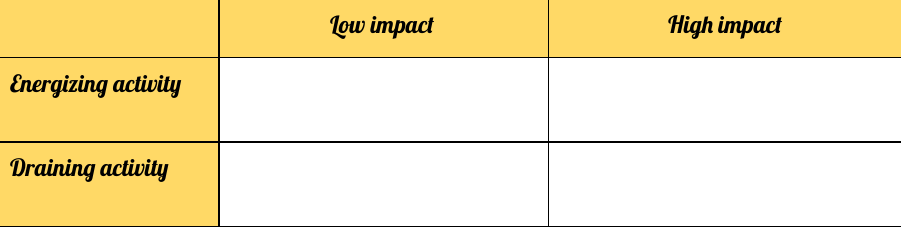
Based on a Positive Intelligence Module by Shirzad Chamine
2 - Ask yourself: What role and actions energize me and have a strong impact on my ecosystem? What can I do to be fully engaged in this role on a daily basis?
3 - Identify who would be in their zone of genius when doing the activities you want to delegate and/or avoid. How can you surround yourself with these people? If you can’t delegate, how can you reduce the drain on your energy while doing it?
"Thereis never enough time to do everything, but there is always enough time to do the most important thing."
And the most important thing should be the one that resonates with you, based on its impact, your talents, and your energy level!
Keep an eye out for the next article on leadership styles that will motivate people to follow you!
Do you want to become the leader you envision for the world you hope to see? Do you want to accelerate your ecosystem’s commitment to the change you hope for? Contact me! Here is a link to an exploratory call and the form to further elaborate on your ambitions and challenges: English

A tool for optimizing impact and energy
- The art of taking on the right role to feel energized, increase your impact, and engage your network.
Combining impact and well-being by simply and fully being yourself. A challenge that our society has completely undermined. Who hasn’t heard the refrain “no pain, no gain” (basically, you have to suffer to succeed)? It’s an insidious refrain that still haunts me sometimes.
What if we could do things differently? What if we could have a positive impact on our ecosystems while having fun? What if taking care of our energy multiplied our impact? It’s possible.
Imagine Lola. Lola is in charge of overseeing her company’s “zero-carbon” plan. She’s well-regarded within her organization. She’s even on the fast track to promotion. Yet she’s on the verge of burnout. Why? Because 70% of her time is devoted to tasks that, while impactful, are draining for her. She does them well. Her expertise is valued. But after each day spent poring over her Excel spreadsheet, she’s exhausted and discouraged. The remaining 30% of her time is split between low-impact distractions and tasks that are neither urgent nor important. Only two innovative operational projects are truly close to her heart. Not very fun. That said, it was thanks to this realization that, within a year, she managed to completely turn the tables.
How? By following three steps:
She is simply asking herself what role she truly wants to play in supporting her company’s ecological transformation. The issue is not so much about what recognition will come with it, but rather what sense of fulfillment, well-being, and alignment would result from it.
Once she has a clear understanding of what truly brings her joy, she assigns the right task to the right person. In doing so, she empowers and motivates the people in her ecosystem while reducing the things that drain her energy. It’s a win-win situation.
Ultimately, she restores a balance among her various activities to align them with her ambition to be an agent of change, her day-to-day actions, and her energy level.
The result?
Greater impact because of more energy,
He no longer has influence over his colleagues because he no longer has the same reach.
Taking Action for Change
1 - Assess the distribution of your activities based on the framework below:
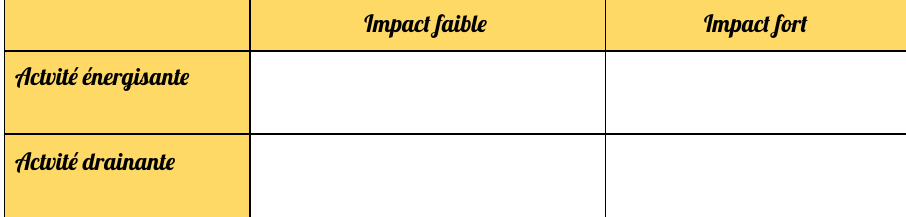
Inspired by a Positive Intelligence module by Shirzad Chamine
2 - Ask yourself: What role and actions energize me and have a significant impact on my ecosystem? What can I do to fully embrace this role every day?
3 - Look around you: Who might be in their zone of genius when doing the activities you want to delegate and/or avoid? How can you surround yourself with these people? If you can’t delegate, how can you reduce the drain on your energy by doing it yourself?
“‘There’s never enough time to do everything, but there’s always enough time to do the most important thing .’ ”
The most important thing should be what you feel aligned with. How can you tell? Assess what that action entails in terms of its impact, how it draws on your talents, and your energy level…
Keep an eye out for the next article on leadership styles that will motivate people to follow you!
Do you want to become the leader you envision for the world you hope to see? Is it time to discover and assert your leadership? Do you want to embed the concepts of positive impact and purpose at the heart of your organization? Is the challenge to accelerate engagement within your ecosystem to drive systemic change?
If your answer is yes and you’d like some guidance along the way, please contact me! Here’s a link to schedule a exploratory session and the form to further explore your goals and challenges.

Sense of Legitimacy and Change Makers
"You know, Nina, I'm not sure I fit in. I'm afraid I won't live up to their expectations. Who am I to lead this project? I want to engage my ecosystem to transform my organization. I want our products to have the least possible negative impact on the environment and society. I want to rethink how we view business success. I'm not an expert. I talk about social and environmental justice, but what do I actually know about it?"
Many of my interactions with my colleagues and clients go something like this. In such cases, my heart and mind are bursting with anger and outrage. The voice in my head says, “But OF COURSE you’re the right person to start this movement and help change the system and its ways!” I know that’s a nice thing to say, but its impact is small and short-lived. How can I get others to believe in themselves? How do I overcome that darn imposter syndrome that I’ve felt so often?
At the risk of disappointing you, there is no magic wand. But here’s one inner truth: you are the right choice simply by being yourself. No one can save the world—least of all on their own. However, as a changemaker, you can make a difference simply by acting in accordance with your vision, your power, your joy, and your circle of allies.
As Isabelle, an inspiring and empowering coach, said: "Legitimacy is the confidence you have in yourself. Self-confidence is an inner reservoir."
Let’s [start to] stop waiting for external approval, which is nice to have but is often a leaky basket of expectations. Let’s take a deep breath and transform this dread of “Do I have the right? Can I? Am I capable of launching this movement for change?” into “It’s time to become the leader I want to be, for the world I envision.”
Taking Action Toward Your Change
Write on paper or on your phone—list at least three of each of the following:
Studies and training programs that provided you with insights or tools to act as a change-maker,
Experiences, successes, and failures that have helped you learn a thing or two about leading change within a given system,
Skills you use so easily that you may have underestimated their value,
The people around you, whether near or far (e.g., a team, a mentor, a friend, podcasts, or books). These resources will support you on your journey.
All of these elements contribute to your “reserve of confidence” and, therefore, to your sense of legitimacy.
Do you really want to squander your fuel of confidence? Is the world such a perfect place that you can avoid doing your part? It is by doing your part, in your own way, that you build your legitimacy. So let me ask you: What role do you want to play in the world today?
In the next article, we'll explore the role you can play in engaging those around you in this systemic change. In the meantime, share your ideas and insights in the comments or by contacting me directly!
“‘Forevil to triumph, all it needs is the inaction of good people.’”
Do you want to become the leader you envision for the world you hope to see? Do you want to accelerate your ecosystem’s commitment to the change you hope for? Contact me! Here is a link to an exploratory call and the form to further elaborate on your ambitions and challenges: English

Legitimacy and Agents of Change
“You see, Nina, I’m not sure I belong here. I’m afraid I won’t live up to their expectations. Who am I, really, to lead this project? I want to engage my network to transform my organization. I want products with as little negative impact as possible on the environment and society. I want to rethink how we measure commercial success. But I’m no expert. I talk about social and environmental justice, but what do I really understand about it?”
Many of my conversations with colleagues and clients go something like this. In those moments, my heart and mind are bursting with anger and outrage. My inner voice says, “But OF COURSE you’re legitimate in starting this movement and contributing to systemic change.” I know that’s a nice thing to hear. Yet it offers only faint and fleeting reassurance. So how do I get them to understand that? How do I dismantle this damn imposter syndrome that I myself know so well?”
At the risk of disappointing you, there’s no magic wand. There is, however, one inner truth: you are authentic simply by being yourself. No one can save the world—let alone on their own. However, as agents of change, you can gain influence and impact by acting in alignment with your vision, your power, your joy, and your circles of allies.
As Isabelle, an inspiring and motivating coach, once said: “Legitimacy is the trust you have in yourself. Self-confidence is an inner reservoir.”
What if we stopped waiting for external approval? It’s a really nice bonus, and yet it’s also often a bottomless pit. What if we took a deep breath and transformed this fear—“But do I have the right? Can I do this? Am I capable of starting this movement for change?”—into “It’s time to be the leader I want to be, for the world I want to see”?
Take Action Toward Change
Take a piece of paper or open a note on your phone. List at least 3 items—this list doesn't have to be exhaustive:
education or training that gives you the understanding and tools to act as an agent of change,
experiences, successes, and “failures” that have helped you learn a thing or two about managing change within a given system,
things you do so easily that you don't even realize their value,
the resources and people around you, whether close by or far away (this could be a team, a mentor, a friend, podcasts, books, and so on). These things nourish you on your journey.
All of these elements feed into your “reservoir” of trust and, therefore, your legitimacy. Do you really want to squander them? Does the world seem to you to be in good enough shape that you can afford not to contribute, no matter how small your contribution may be? It is by doing your part, in your own way, that you earn your legitimacy. What role do you want to play in the world today?
In the next article, we’ll explore the role you can play in engaging those around you to bring about systemic change. In the meantime, please share your ideas and thoughts. This is very helpful in understanding your needs and aspirations.
“‘Forevil to triumph, all it needs is the inaction of good people.’”
Do you want to become the leader you envision for the world you hope to see? Is it time to discover and assert your leadership? Do you want to embed the concepts of positive impact and purpose at the heart of your organization? Is the challenge to accelerate engagement within your ecosystem to drive systemic change?
If your answer is yes and you’d like some guidance along the way, please contact me! Here’s a link to schedule a exploratory session and the form to further explore your goals and challenges.

Want to engage people? Act as a Change Multiplier!
This is the second article in a series on ways to engage your ecosystem to change the world. The first article focused on the mindset needed to most effectively influence one’s surroundingss.
Change multipliers challenge the way they interact with others
The scale and urgency of our environmental and social challenges may overwhelm even the most rational and motivated sustainability advocate. Faced with such a daunting goal, this advocate—determined to transform our work, consumption, and production patterns—may be tempted to impose radical changes too quickly. Yet what seems like the best course of action in the short term may not be the most effective strategy for engaging people in the long term.
According to Liz Wiseman and Greg McKeown (see the book*Multipliers: How the Best Leaders Make Everyone Smarter*), the multiplier’s leadership is based on the belief that anyone can figure out problems on their own, even if they seem to struggle at first.
One might conclude that the role of a leader committed to fostering sustainability would be to set the vision, bring together aspiring changemakers, and create the right conditions to unleash people’s best ideas and creative efforts—rather than micromanaging every step of the way.
Change multipliers act as challengers
This kind of leader is able to turn anxiety into trust and determination. Here is an example of how a multiplier motivated others to overcome uncertainties:
“We are facing an unprecedented crisis around the world. This situation could become an opportunity for our organization. Let’s completely rethink our business models to demonstrate that a company can thrive while preserving nature, nurturing employees, and co-creating with its external partners. I need you to take on this ambitious challenge. Here are my questions to help guide your brainstorming: Why are we in this business? How useful are we to the planet and its citizens today? What would it take to be 100% purpose-driven? I don’t need 100% complete answers right now. I need us to grasp about 30% of the answers so we can figure out how to allocate our time and resources to find 100% of the answers in the coming months. I trust your commitment to the company. Refocus on what drives you in life and work. I will support you.”
At the other end of the spectrum, changemakers who act as “diminishers” might retain control over every detail, telling others what to do and how to proceed. They would come up with both the questions and the answers, turning others into robots carrying out orders. They might also lower expectations to ensure that targets are met.
Currency exchange multipliers act as investors
Such leaders engage their ecosystem because they foster a sense of ownership and motivate action through an inspiring vision.
“‘Ifyou want to build a ship, don’t focus on gathering wood, dividing up the work, and giving orders. Instead, teach them to long for the vast and endless sea .’”
Allowing yourself and others to dream big about your future goals will provide a motivating compass for the long term. It will also prevent you from focusing all your efforts solely on that higher goal.
Taking Action Toward Change
Every day, calm your busy, anxious mind with empowering thoughts, such as:
People are smart and can figure things out.
I give myself permission to stumble as I develop new, habit-multiplying habits
Change is a journey
Lasting change depends on my ecosystem’s commitment and support
Refine your engagement strategies by asking yourself these questions:
Based on my role and the value I bring:
What do I need to focus on to ensure that our sustainability mission is implemented smoothly?
How can I draw on the talents of others to tackle the remaining challenges?
What would enable other people around me to appear more capable of working toward systemic change?
How can questions help people take ownership of the vision and illuminate the path forward?
“‘WhenI let go of who I am, I become who I might be.’”
Feel free to share your thoughts with me, and stay tuned for the next article. We’ll explore ways to strengthen your sense of legitimacy as a change leader!
If you want support to become the leader you want to be for the world you envision, and if you want to accelerate your ecosystem’s commitment to the change you hope for, contact me! Here is a form to help you further elaborate on your ambitions and challenges: English

Want to inspire others? Become an agent of change!
Here is the second article in a series on how to engage your ecosystem to change the world. The first article focused on the mindset needed to most effectively influence those around you. I’ll use the masculine form to make the text easier to read. I’ll switch it up next time. These articles are for everyone!
Agents of change are challenging
the way they interact with others
The scale and urgency of our environmental and social challenges may be too much for any rational, motivated individual to handle. Faced with such a daunting goal, that individual—eager to transform the way we work, consume, and produce—may be tempted to impose very radical changes very quickly. However, what seems to be the best change in the short term may not be the best strategy for engaging one’s ecosystem in the long term.
According to Liz Wiseman and Greg McKeown (in their book, *Multipliers: How the Best Leaders Make Everyone Smarter*), multiplier leadership is based on the belief that anyone can solve problems on their own, no matter how difficult the starting point may be.
One might conclude that the role of a leader who wishes to promote the sustainability of a system and an organization is to define an ambitious vision, bring together change agents to engage all stakeholders in the system, and create the conditions that allow everyone to generate the best ideas and take action—rather than directing and controlling every step of the process.
CHANGE AGENTS IN ACTION
LIKE CHALLENGERS
This type of leader is capable of turning anxiety into confidence and determination. Here is an example of how a “multiplier” might motivate their team to overcome uncertainties:
"We are facing an unprecedented crisis around the world. This situation can become an opportunity for our organization. Let’s transform our business models to demonstrate that a company can thrive while preserving nature, taking care of its employees, and co-creating with its external partners. I need you and your ideas to tackle this ambitious mission. Here are some questions to guide you: Why do we do this work? How are we serving the planet and its people today? What would it take to fully embody our purpose? I don’t need all the answers right now. I need about a third of them to help me figure out how to allocate our time and resources so we can find all the answers in the coming months. I have confidence in your commitment. Refocus on what drives you in life and at work. I’ll support you.”
At the other end of the spectrum, change agents who act as “diminishers” might try to control every detail, telling others what to do and how to do it. They would generate both the questions and the answers, turning others into robots carrying out orders. They might also scale back ambitions to ensure they are achieved.
CHANGE AGENTS IN ACTION
LIKE INVESTORS
These leaders engage their ecosystem because they encourage everyone to take ownership of their goals and motivate action through an inspiring vision.
“‘Ifyou want to build a ship, don’t look for people to gather wood or assign them tasks; instead, teach them to yearn for the infinite vastness of the sea.’”
By allowing yourself and others to dream about the world you want and what you want to create in the future, you provide a source of long-term motivation. This will also make your day-to-day life easier and prevent you from having to focus every step on the ultimate goal.
take action to bring about change
Every day, calm your anxious, busy mind with supportive thoughts. Here are some examples:
People are smart and can solve any problem. I'm here to support them, not to save them.
I give myself permission to stumble as I cultivate new habits as an agent of change.
Change is a journey. It takes time and is full of surprises.
Sustainable change depends on the commitment and support of my ecosystem.
Refine your engagement tactics with these questions:
Given my role, talents, and skills:
What should I focus on to ensure that our transformation mission—guided by the key principles of sustainable development—is implemented smoothly?
Now that this has been established, how can I leverage the talents of my team and allies to tackle the remaining challenges?
What would make the other members of my ecosystem proud of their contribution to systemic change?
What questions could help individuals embrace the vision and enable them to chart the way forward?
“ ‘WhenI let go of who I am, I become who I could be.’ ”
Feel free to share your thoughts with me, and stay tuned for the next article. We'll explore ways to strengthen your sense of legitimacy as a change leader!
Do you want to become the leader you envision for the world you hope to see? Is it time to discover and assert your leadership? Do you want to embed the concepts of positive impact and purpose at the heart of your organization? Is the challenge to accelerate engagement within your ecosystem to drive systemic change?
If your answer is yes and you’d like some guidance along the way, please contact me! Here’s a link to schedule a exploratory session and the form to further explore your goals and challenges.

Your mindset can expand your sphere of influence
The way you engage people in the change you hope to bring about in the world will vary greatly depending on whether you think they are “uneducated,” “lost,” “disingenuous,” “dangerous,” or, on the contrary, “intelligent,” “sharp,” “capable,” and “more competent” than you in some areas.
Liz Wiseman and Greg McKeown’s book,*Multipliers: How the Best Leaders Make Everyone Smarter*, sparked valuable reflections for leaders. It offers insights for changemakers striving for individual and organizational transformation toward a more resilient, grounded, nature-centered, and humanistic world.
Who am I? A diminisher or a multiplier?
According to Wiseman and McKeown, there are two types of leaders:
“The first type drains intelligence, energy, and ability from the people around them and always needs to be the smartest person in the room. These are the diminishers”
(...) At the other end of the spectrum are leaders who use their intelligence to enhance the capabilities of those around them. These are the Multipliers.”
It seems pretty straightforward and easy, right?
Well, spoiler alert: the distinction is much more subtle than it seems. Depending on the context and our stress level, we can all act as "diminishers" or "multipliers." Often, "diminishers" don't act this way on purpose.
To overcome internal resistance, I am willing to be vulnerable (believe me, this is uncomfortable) by sharing my own struggles and discoveries:
I remember feeling encouraged when I discovered behaviors, stories, and tools that empowered me to continue acting as a catalyst for change in my organization and within my team.
Yet, I also remember how frustrated and ashamed I felt when I saw the results of the multipliers’ quiz: “You may unintentionally act as a diminisher.”
For example, I discovered that one of my key strengths—my creativity, also known as the “Idea Fountain Tendency”—could potentially cause organizational turmoil.
If my intention was to add value and spark ideas in others, it might also overwhelm them to the point of causing them to shut down.
What a shock to me! After years of leadership training, I thought people should build on their strengths rather than focus on their weaknesses!
Taking Action Toward Change
After taking a deep breath, the coach in me was able to reconnect with my growth mindset. I therefore looked for tips on how to navigate such risks and make the most of my strengths.
This anecdote shows that the issue of "multipliers" versus "diminishers" requires more attention than it might seem. It also highlights the risk of dichotomies such as "it's black or white."
So, with that in mind, what can you do to act as a catalyst for change?
First, I invite you to take the quiz.
Take the time to embrace these insights. They are merely a guide, not an absolute truth. That said, they may hold valuable lessons that can help you grow and make an impact.
Next, start paying attention to your mindset and try out some of their practical tips to change your behavior!
Last but not least, stay tuned (sign up for the newsletter if you haven't already) for the next chapter in the series!!! We'll explore ways to position yourself as a "change multiplier" to engage your ecosystem!
“Bean encourager—the world has enough critics already.”
Feel free to share how this article resonates with you—I’d love to hear from you. Also, if you’d like support in becoming the leader you want to be for the world you envision, contact me! Here’s a form to help you further explore your ambitions and challenges: English

Your mindset can expand your sphere of influence
The way you engage others in support of the change you hope to see in the world depends largely on your perception. You’ll act differently depending on whether you think you’re dealing with people who are “uneducated,” “lost,” “dishonest,” or “dangerous,” or, on the contrary, with individuals who are “intelligent,” “knowledgeable,” “capable,” and “more competent than you” in certain areas.
The book by Liz Wiseman and Greg McKeown titled "Multipliers: How the Best Leaders Make Everyone Smarter” (Multipliers: How the Best Leaders Make Everyone Smarter) is enlightening for leaders. I find that it also offers insights for change agents striving to transform individuals and organizations toward a more resilient, more sustainable, more nature-centered, and more humanistic world.
Who am I? A “diminisher” or a “multiplier”?
According to Wiseman and McKeown, there are two types of leaders:
"The first type drains the intelligence, energy, and abilities of those around them and always needs to be the smartest person in the room." These are the “diminushers.”
(...) At the other end of the spectrum are leaders who use their intelligence to amplify the capabilities of those around them.” These are the “multipliers.”
Translation by Deepl.com
That sounds pretty simple and easy, doesn't it? I imagine that most people reading this distinction consider themselves to be the second type of leader.
Well, listen up. Here’s a revelation. The distinction is much more subtle than it seems. Depending on the context and our stress levels, we can all act as “diminishers” or “multipliers.” In fact, those who diminish others often don’t do so intentionally.
To defuse any internal resistance, I’m willing to show vulnerability (believe me, it’s uncomfortable) by sharing my own struggles and discoveries:
I remember feeling inspired while reading this book. I discovered behaviors, stories, and tools that enabled me to continue serving as a catalyst for change in my organization and within my team.
Still, I also remember the frustration and shame I felt when I saw the results of the online quiz: “You may accidentally come across as a ‘diminisher.’”
For example, I discovered that one of my greatest strengths—my creativity (what they call the “idea-generating tendency”)—could give my organization a real boost.
While my intention was to add value and spark new ideas in others, this energy could also overwhelm the people I was talking to and cause them to withdraw into themselves.
What a shock! After years of training in leadership and coaching, I thought people were supposed to build on their strengths rather than focus on their weaknesses! Should we doubt our strengths? Should we be paranoid every time we say or do something?
Take Action to Bring About Change
After processing this news, the coach in me was able to reconnect with my “growth mindset.” I realized that it was about channeling my strengths effectively to serve my ecosystem—not stifle it. I looked for ways to mitigate these risks and make the most of my talents.
This anecdote is meant to show you that the issue of “multipliers” versus “diminishers” requires more attention than it might seem at first glance. It’s also meant to highlight the risk of “black-and-white” dichotomies.
So, now that this point has been clarified, what can we do to act effectively as a “change multiplier”?
First, I invite you to fill out the questionnaire.
Take the time to reflect on the results. This is merely a framework for interpretation, not an absolute truth. That said, it may hold valuable insights for your growth and impact.
Next, start observing your state of mind and try out some of their practical tips to boost your impact!
Finally, and most importantly, keep an eye out (and sign up for the newsletter if you haven’t already) for the next chapter in the series!! We’ll explore ways to position yourself as a “change multiplier” to engage your ecosystem!
"Encourageothers—the world already has enough naysayers."
Do you want to become the leader you envision for the world you hope to see? Is it time to discover and assert your leadership? Do you want to embed the concepts of positive impact and purpose at the heart of your organization? Is the challenge to accelerate engagement within your ecosystem to drive systemic change?
If your answer is yes and you’d like some guidance along the way, please contact me! Here’s a link to schedule a exploratory session and the form to further explore your goals and challenges.

How can you bring people together to work toward a sustainable world?
Engaging all levels of an organization on sustainability is a recurring challenge. As I tried to write an article addressing this issue, I got stuck. Really stuck. A complete blank. Nothing. Why? Simply because it seems impossible to tackle this intractable problem all at once. There are so many aspects to consider, such as:
Your mindset—What are your views on the people you want to attract? Are they people you need to “educate”? Are they threats you want to mitigate? Or are they important influencers from whom you expect support?
Your legitimacy—What role will you choose on this journey? Will you be a passenger or a driver? How will you exercise your leadership?
Your target audience—Do you want to reach top-level executives, middle management, or operational staff? Beyond your immediate circle of influence, who should your ecosystem partners be?
Your influence—How do you plan to persuade the diverse group of people with different personalities and backgrounds that you will interact with?
Your strategy - What is your main goal? How will you engage people? What tactics could you use to achieve this?
To convey a concise and more dynamic message, I'll write a series of short articles (about 2 minutes each) on the topic.
Since our actions are largely determined by our thoughts, I’ll start with the topic of mindset! Take a look at the first chapter, “Your mindset can expand your sphere of influence.”
Feel free to share how this article resonates with you—I’d love to hear from you. Also, if you’d like support in becoming the leader you want to be for the world you envision, contact me! Here’s a form to help you further explore your ambitions and challenges: English

How can you bring people together to work toward a sustainable world?
As I tried to write an article addressing this concern, I hit a wall. I was really stuck. A complete blank. Nada. Why? Simply because it seems impossible to tackle this issue all at once.
There are so many factors to consider, such as:
Your mindset— What do you think of the people you want to attract? Are they people you need to “educate”? Are they threats you want to neutralize? Or are they influencers whose support you’re counting on?
Your Legitimacy —What role will you choose on this journey? Will you be a passenger or a driver? How will you exercise your leadership?
Your Target Audience —Do you want to reach the executive committee, middle management, or front-line staff? Beyond your immediate circle of influence, what is your ecosystem? Who are your partners?
Your Influence— How do you plan to persuade the diverse range of individuals and roles you will be interacting with?
Your Strategy - What is your main goal? How do you want to engage people? What tactics could you use to achieve this? What specific actions will you take?
To convey a concise and more engaging message, I will write a series of short articles on the topic.
Since our actions depend mainly on our thoughts, I'll start with the topic of mindset. Take a look at the first chapter, " Your Mindset Can Expand Your Sphere of Influence."
Do you want to become the leader you envision for the world you hope to see? Is it time to discover and assert your leadership? Do you want to embed the concepts of positive impact and purpose at the heart of your organization? Is the challenge to accelerate engagement within your ecosystem to drive systemic change?
If your answer is yes and you’d like some guidance along the way, please contact me! Here’s a link to schedule a exploratory session and the form to further explore your goals and challenges.

To be or not to be: that is the question (for changemakers)
In my last article, I explored how people influence our ability to become change-makers and to launch movements. It turns out that if it takes “two to tango,” you’d better be bold enough to take the first step. That said, a few questions remain. How should we make the first move? In which direction? Are all change strategies created equal?
To bring about a systemic shift, one might wonder whether it is wiser to implement a single action on a massive scale; to sow several seeds at the same time; to deconstruct the system; or to remove oneself from it. I have often wondered what would generate the greatest momentum:
Focusing on specific scalable, industrialized initiatives?
Toning down ambitions with quick wins to please potential allies first?
Do you plan to act as a “lone wolf” when launching new initiatives, until others join you?
Escaping the crowd and building an ecosystem from scratch?
All strategies differ, and each has its own advantages, disadvantages, and unique characteristics. Still, one principle may help classify them into two main categories of options: deciding whether to [act like a] bee or not to be a bee.
The Bees: Attributes and Limits of Change Makers
Bees may seem both scary because of their sting and fragile because of their size and short lifespan. Today, these insects are disappearing, and few people realize the tremendous consequences this has for humanity—beyond the lack of honey and its rising market prices.
Bees actually play a much more important role in life on Earth. Consider the following, for example:
Flora: Beyond soil, water, and sunshine, the vast majority of plants depend on cross-pollination to grow. Guess who is one of the main pollinators? Bees!
Life cycle: At least 20 species of birds, spiders, and insects rely on bees for food.
Food chain: Bees pollinate billions of plants each year. In fact, pollinators such as bees play a key role in 35% of the world's food crops.
Economy: “The economic value of global crops that directly depend on pollinators, including bees, is estimated to be between US$235 billion and US$577 billion a year,” according to the FAO, the Food and Agriculture Organization of the United Nations.
You may wonder how that relates to changemakers and change-making strategies… Well, just like bees, changemakers may seem small, insignificant, or even scary to other members of their ecosystems. Yet they are vital for the ecosystem to survive and thrive.
The Bees' Changemakers Strategy
Bees also perfectly illustrate key principles of change management. Here are four key ones:
1. Change starts from within:
To build momentum, it is necessary to start change from the inside out and lead by example. During the first few days of their lives, bees clean the interior of the hive and then feed the larvae hatched from the queen’s eggs. After that, they produce wax and take up positions at the hive’s entrance to defend it. Finally, for the rest of their lives, they pollinate flowers in the outside world.
2. Change is gradual and comprehensive:
Working hard and steadily, across multiple dimensions, is crucial when striving for global impact. Bees are well known for their tireless determination and constant work in the hives and through pollination. They move from flower to flower, pollinating one after another. They create synergies among all plants through the pollen they transport. They “connect the dots” in an incredible and, each time, unique way. While each act may seem insignificant on its own, it affects the lives of thousands upon thousands of species.
3. Change resulting from individual and collective actions:
Leveraging your talents while seeking out complementary skills within your community will nurture your ecosystem. We often think of ants when it comes to structured teamwork. Yet the bee is another living example of the benefits of group work—both for the community and for the individual. The division of labor occurs naturally and harmoniously. Their wide variety (over 20,000 species) and their ability to fly and explore the world give them a sense of freedom that I somewhat envy.
4. Change is purposeful:
Believing in your higher purpose and enjoying the journey will lead you to success! While the bee is a serious and dedicated worker, she also embodies the joy of discovery, connection, and living in the moment. Above all, it is the satisfaction of a job well done and the joy of devoting oneself to a cause that transcends one’s ordinary limits. In pursuing their mission, bees provide numerous, vital social, environmental, and economic benefits to human life on Earth. Make no mistake: these benefits are the result of their dedication to the greater good.
Do “all roads lead to Rome”?
I’ve been debating A LOT with friends and peers about the initial question: “Which strategy is best for bringing about systemic change for the benefit of the planet?” Given that truth and efficiency are among my core values, questions like these have filled me with uncertainty and fueled my imposter syndrome.
I realized that, without even realizing it, I wanted to reach the end of the journey in order to discover the real answer. Clearly, this would make me unable to offer a solution to those who were still on their journey. I reasoned that life is worth exploring and worth living.
A systemic shift cannot occur with just one solution. I have come to accept the fact that most of the solutions are already known in some form, and that the main obstacle is our tendency to argue rather than to change. As strange as it may seem, I even wonder if it’s really worth trying to determine which strategy for bringing about change is best for achieving a sustainable, harmonious, and nature-centered world.
“Is the grass greener on the other side?”
Rather than revealing dilemmas or limitations, these questions have shaped my approach to being a changemaker. I’ve come to realize that my value lies in bridging theory and action. I embrace my holistic and multidimensional perspective. Rather than being ashamed of this leadership style, I am now willing to act like a bee in an industrialized world. I have neither the courage nor the will (yet) to disconnect myself from my current ecosystem (whether I like it or not).
Still, I don’t buy into the “one-size-fits-all” solution. I like to test and cross-pollinate solutions with other changemakers. I like to recognize the power I see so clearly in others—the engineers, intrapreneurs, entrepreneurs, public servants, doctors, journalists, researchers, and the many other changemakers who surround me. I believe in sowing multiple seeds, depending on the contexts and constraints. I know some will not flourish. I know some will only thrive in a specific environment, while others may thrive anywhere. These realizations have helped me let go of the pressure to determine which change-making strategy is the best. Above all, they have driven my desire to act as a leader, a critical friend, a creator, a writer, a coach, and a facilitator.
Bringing About Change
Rather than pointing out the shortcomings of others’ genuine efforts to bring about positive change, why not work together to prevent changemakers from disappearing?
I have a (quick) challenge for you today. Are you up for it? I invite you to answer these questions and share your thoughts:
To be or not to be?
Are you ready to embrace your own leadership and changemaker style?
Can you share your unique strategies with other changemakers?
Whether privately or on your favorite social media platform, I invite you to tag and recognize one changemaker and his or her contribution today.
Thanks to all the Bees who are showing us the way
Feel free to share how this article resonates with you—I’d love to hear from you. Also, if you’d like support in becoming the leader you want to be for the world you envision, contact me! Here’s a form to help you further explore your ambitions and challenges: English
![To be or not to be [a bee]: that is the question for the women* driving change](https://images.squarespace-cdn.com/content/v1/6a58b14e3f5da053c479b850/1784197459670-QMHN40ZP3EGN0SBNXH5D/Screenshot+2021-08-16+18.15.14.png)
To be or not to be [a bee]: that is the question for the women* driving change
* To make it easier to read, the words are in the feminine form this time. Far be it from me to exclude men… quite the contrary!
My last article focused on how others can influence us to become agents of change and launch movements. It turns out that while it takes “two to tango,” it’s best to take the first step. That said, a few questions remain. How do you get started? In which direction? Are all strategies for change equally effective?
To bring about systemic change, I have often wondered what would have the greatest impact:
Focus on the theory and the vision, and let others take it from there?
Create initiatives that are easily replicable and “scalable”?
Focus on “quick wins” to win over potential allies?
Should we act like a lone wolf, launching initiatives until others join us?
Escape the crowds and create an ecosystem from scratch?
All strategies are different. Each has its own advantages, disadvantages, and unique characteristics. Nevertheless, one principle can help classify them into two broad categories of options: whether or not to act like a bee [“To bee or not not bee”].
The Added Value of “Bees as Agents of Change”
Bees may seem both frightening because of their stingers and fragile because of their size and short lifespan. Today, these insects are endangered, and few people grasp the far-reaching consequences this has for humanity—other than the shortage of honey and its rising market price.
In fact, bees play a much more important role in life on Earth. Here are a few examples:
Flora: Beyond soil, water, and sunlight, the vast majority of plants depend on cross-pollination to thrive. Guess who one of the main pollinators is? Bees! They pollinate billions of plants every year.
Life cycle: At least 20 species of birds, spiders, and insects rely on bees for food.
Food Chain: Pollinators such as bees play a key role in 35% of the world's food crops.
Economy: "The value of global crops that depend directly on pollinators is estimated at between $235 billion and $577 billion per year," according to the FAO, the Food and Agriculture Organization of the United Nations.
You might be wondering what this has to do with change agents and their strategies...
Just like bees, agents of change may seem small, insignificant, or even frightening to other members of their ecosystem. Yet they are essential to the survival and development of that very ecosystem.
The "Bees as Agents of Change" Strategy
Bees are a perfect illustration of the principles of change management. Here are the four main ones:
1. Change starts with yourself:
To create momentum, it is necessary to initiate change from within and lead by example. During the first few days of their lives, bees clean the inside of the hive, then feed the larvae hatched from the queen’s eggs. Next, they produce wax and take up positions at the hive’s entrance to defend it. Finally, until the end of their lives, they pollinate flowers in the outside world.
2. Change is gradual and holistic:
Working hard and steadily, across multiple dimensions, is crucial when aiming for a global impact. Bees are well known for their tireless determination and constant work in the hive and through pollination. They move from flower to flower, pollinating them one after another. They create synergies among all plants through the pollen they carry. Bees create invisible connections in incredible and, each time, unique ways. While each individual action may seem insignificant on its own, it affects the lives of thousands upon thousands of species.
3. Change results from individual and collective actions:
By making the most of our talents while seeking out complementary strengths within our community, we nurture our ecosystem. We often think of ants when it comes to teamwork. Yet the honeybee is another vivid example of the benefits of working together, both for the community and for the bees themselves. The division of labor occurs naturally and harmoniously. Their great diversity (more than 20,000 species) and their ability to fly and explore the world give them a sense of freedom that I greatly envy.
4. Change has a purpose:
Believing in our mission and finding joy along the way paves the way to success! While the bee is a hardworking and dedicated creature, it also embodies the joy of discovery, connection, and embracing the here and now. The bee embodies the satisfaction of a job well done and the joy of dedicating oneself to a cause that transcends its own limits. Bees provide numerous and crucial social, environmental, and economic benefits to human life on Earth. Let’s not be mistaken: these benefits are the result of their dedication to their mission.
Is it true that "all roads lead to Rome"?
I had many discussions with my friends and peers about the initial question: “What is the best strategy for bringing about systemic change for the good of the planet?” Since truth and effectiveness are among my core values, I felt, each time, a great deal of uncertainty and imposter syndrome.
After a while, I realized that I subconsciously wanted to reach the end of the journey to discover the true answer. Obviously, that would make me unable to offer a solution to those who are still on their way. So, I decided to take a chance and believe that life is simply worth experiencing and living, with all its mistakes and successes.
As strange as it may seem, I even wonder if it’s really useful to assess which change strategy is best for achieving a sustainable, harmonious, and nature-centered world. It’s impossible to bring about systemic change with a single solution. I agreed to reframe the issue. Ultimately, the challenge is to accept that most solutions are, in a sense, already known, and that the main obstacle is our tendency to resist and debate rather than to change.
"Is the grass greener on the other side?"
Rather than revealing dilemmas or limitations, these questions have shed light on how I can be an agent of change. Rather than trying to be someone other than who I am and feeling ashamed of this style of leadership, I am now ready to act like a bee in an industrialized world. I’ve come to understand that my value lies in reconciling diverse worlds—theory and action, intuition and reason. I have decided to have confidence in my holistic and multidimensional approach. For now, I have neither the courage nor the will to disconnect from our current system, whether I like it or not. Yet I do not subscribe to the status quo, nor to the rational logic of one-size-fits-all solutions. I believe in harmonious transformation from within.
I enjoy testing and cross-pollinating solutions with other change-makers. I enjoy highlighting the power I see so clearly in others—engineers, intrapreneurs, entrepreneurs, civil servants, doctors, journalists, researchers, volunteers, and the many other change-makers around me.
I believe we need to plant several seeds, depending on the circumstances and constraints. I know that some won’t bloom. I know that some will only thrive in certain environments, while others can flourish anywhere. These realizations have allowed me to ease the pressure I put on myself regarding the best strategy for change. But above all, they have fueled my desire to act as a leader, artist, advocate, critical friend, coach, and facilitator.
Drive Change
Rather than pointing out the flaws in others’ sincere efforts to bring about positive change, why not work together to prevent the disappearance of these agents of change?
I have a (quick) challenge for you today. Are you ready to join me? I invite you to answer and respond to these questions:
What kind of bee do you want to be?
Are you ready to embody your own style of leadership and change?
Can you share your unique strategies with other change-makers?
If so, whether privately or on your favorite social media platform, I invite you today to highlight and celebrate an agent of change and their contribution.
Thank you …
To all the bees that show us the way!
Please feel free to share your feedback on this article.
Do you want to become the leader you envision for the world you hope to see? Is it time to discover and assert your leadership? Do you want to embed the concepts of positive impact and purpose at the heart of your organization? Is the challenge to accelerate engagement within your ecosystem to drive systemic change?
If your answer is yes and you’d like some guidance along the way, please contact me! Here’s a link to schedule a exploratory session and the form to further explore your goals and challenges.

Can you be a changemaker without allies?
Many of you may have seen this video in which Dereck Sivers explains why it takes two people to start a movement. In this case, one person dares to dance and looks a little strange. People laugh. Then, someone else joins in. Gradually, the crowd begins to join the dancers.
This example is an inspiring invitation to take a leap of faith when you’re ready to take action. It reminds us of how social movements work. When you’re ready to act as a changemaker, you will ALWAYS face resistance. But studies show that it only takes 20 percent of a group to bring about change.
Still, I can’t help but wonder: where do we start? Do changemakers become changemakers because of external recognition or self-recognition? Do we first need allies to become changemakers?
The Power of “Otherness” to Shape Your Identity
The philosopher Hegel argued that individuals can only develop an objective awareness of their values through their relationships with others. Such a view would explain the shift in the group’s dynamics mentioned earlier. The person who started the dance went from looking like a fool to looking like a star, thanks to the reactions of the others.
“Man is human only to the extent that he tries to impose himself on another man in order to be recognized by him. As long as he has not been effectively recognized by the other, it is this other who remains the focus of his actions. His human worth and reality depend on this other and on his recognition by the other. It is in this other that the meaning of his life is condensed.” Alexandre Kojeve, Introduction to the Reading of Hegel
How powerful and dangerous our relationships with others can be! In their eyes, we seek the recognition we desire for ourselves. If they offer it to us, that’s great. But if not, what happens? Who is right? Can self-awareness stand on its own? Is external perception alienating us? Do we have to fight to the death to shape our own identity? How can we free ourselves in harmony?
According to Descartes’ statement , “I think, therefore I am,” our consciousness alone provides proof of our existence. In that sense, one might think that we simply need to see ourselves as changemakers in order to be one. Holding such a core belief may indeed give you the strength to dare to act while trusting that allies will join you. Rather than diminishing your value as a changemaker, observers’ reactions—such as laughter and skepticism—may actually offer insights into your power to bring about change!
The Power of “Otherness” to Boost Your Impact
I guess these two perspectives, which might seem contradictory, are actually complementary. Our initial personal intention to bring about change—though it may be vague and uncertain—gives us the strength to step forward as agents of change. Our determination, passion, and action enable us to attract supporters, reaffirm our intuitions, and build greater momentum. That said, what else is possible with the help of others?
First, let’s start by clarifying that there is a difference between detractors, allies, and brainwashed executors.
According to the Merriam-Webster dictionary, “an ally is someone associated with another as a helper—a person or group that provides assistance and support in an ongoing effort, activity, or struggle.”
At a 2008 press conference, Barack Obama explained why he had chosen Hillary Clinton to be part of his team:
“I assembled this team because I am a firm believer in strong personalities and strong opinions. I think this is how the best decisions are made. One danger in the White House is that you can get caught up in a group where everyone agrees on everything. So I am going to encourage vigorous debate within the White House. Understand that I will be setting policy as president; I am responsible for the vision that this team carries out, and I expect them to implement that vision once decisions are made.”
Input from our allies will most likely provide a variety of positive and constructive insights that will help our project grow. With their help, we can identify hidden gaps and generate new ideas to strengthen both our vision and our roadmaps.
“If you want to go fast, go alone; if you want to go far, go together.”
Thisproverb is used a lot in my circle these days. I have mixed feelings about it. I love collaboration. I couldn't have developed as many projects as I have if I had worked alone. The results and outcomes would also be less comprehensive, high-quality, creative, or even practical without my wonderful team members.
Since my goal is to embed principles of purpose and sustainability into the core business, it is absolutely essential that every level of the company be on board. However, I realize that I may often feel frustrated by the time it takes to explain, persuade, and wait for other groups to buy in.
Our ambition is to bring about an organizational shift. Should we scale back our ambitions and postpone initiatives while focusing on internal advocacy to convince everyone first? Should we coach people to discover their own motivations for action first? Or, on the contrary, should we act as challengers and changemakers to drive disruption? I can’t really choose just one approach, and I hope there’s room for all of them.
The answer may lie in our ability to acknowledge and unleash our own truth and genius, and then inspire others to co-create. I've spent a lot of time experimenting with and learning variousways to do this, but that's a story for another day ;D
While waiting for new insights, one might conclude that you first need to trust yourself to become a changemaker before inviting others to help build the movement. Are you ready to position yourself as a changemaker?
UPDATING YOUR CHANGE
A Simple Tool
Think of two changemakers you respect and admire:
What do they have in common that inspires you?
What does that say about your (hidden) hopes for yourself and your life?
If you could be as free as a bird, what kind of changemaker would you like to become?
What is the first small step you can take in that direction today?
Who can help you stay confident and accountable for taking such action?
A Mantra
"Liveyour passion and share your dream"
Now it's your turn!
I challenge you to have the courage to acknowledge your inner truth and share your thoughts with me!
Feel free to share how this article resonates with you—I’d love to hear from you. Also, if you’d like support in becoming the leader you want to be for the world you envision, contact me! Here’s a form to help you further explore your ambitions and challenges: English / French

Can you be an agent* of change without allies?
* To make the text easier to read, the words are in the masculine form. Far be it from me to exclude women from the process or from reading this!
Many of you may have seen this video in which Dereck Sivers explains why it takes two people to start a movement. Here, one person dares to dance and looks a little strange. People laugh. Then someone else steps forward and dances. The crowd follows and gradually joins in with the dancers.
It’s an inspiring call to “take the plunge” when you want to do something. It also reminds us of how a movement works. As agents of change, we are ALWAYS faced with resistance. But studies show that it only takes 20% of motivated people to shift the direction of a group.
That said, one question remains: Where do we start? Do agents of change become true agents of change through external recognition or by recognizing themselves as such? Do we first need allies to become agents of change?
The Power of “Otherness” to Shape Your Identity
The philosopher Hegel argued that a person can only gain an objective awareness of their own worth through their relationships with others. Such a position would explain the shift in group dynamics mentioned earlier. The person who started the dance went from being an idiot to a star, thanks to the reactions of the others.
“A person is human only to the extent that he seeks to assert himself over another person and to be recognized by that person. At first glance, as long as he has not yet been effectively recognized by the other, it is this other who is the goal of his action; it is on this other—on recognition by this other—that his human value and reality depend; it is in this other that the meaning of his life is concentrated. He is therefore outside of himself.” Alexandre Kojève, Introduction to the Reading of Hegel.
How powerful—and dangerous—our relationships with others can be! In their eyes, we seek the recognition we desire for ourselves. If they offer it to us, so much the better. But if they don’t, what happens? Who is right? Can self-awareness be sufficient in and of itself? Does external perception alienate us? Must we fight to the death to shape our own identity? How can we free ourselves harmoniously?
In accordance with Descartes’ statement,“I think, therefore I am,” our consciousness alone provides proof of our existence. In this sense, one might think that simply seeing oneself as an agent of change is enough to be one. Holding such a conviction can indeed give you the strength to dare to act while trusting that allies will join you. It also helps you understand that the laughter and skepticism of some observers are, in a way, proof of your disruptive power! You’re challenging the norm by calling for change!
The Power of “Otherness” to Boost Your Impact
I believe that these two positions, which at first glance seem contradictory, are in fact complementary. Our initial intention to bring about change—even if it may be vague and uncertain—gives us the power to act as agents of change. Our determination, passion, and action then enable us to attract allies, reinforce our intuitions, and spark a movement.
That said, what else can we do with the help of others? First of all, let’s start by clarifying that there is a difference between detractors, allies, and those who are simply passive participants.
According to the Larousse dictionary, "an ally is a person or group that provides help and support. It is also a country with which one is united by a treaty."
At a press conference in 2008, Barack Obama explained why he chose to have Hillary Clinton on his team (translated by Deepl):
"I put this team together because I firmly believe in strong personalities and strong opinions. I think that's how the best decisions are made. The danger in the White House is ending up in a group where everyone agrees on everything. So I’m going to encourage vigorous debate in the White House. Understand that I will set policy as president; I am responsible for the vision this team embodies, and I expect them to carry out that vision once decisions are made.”
Contributions from our allies will most likely provide a variety of friendly and constructive perspectives to help a project move forward. With their help, we can identify its shortcomings and enrich it with new ideas to strengthen our vision and roadmap.
“If you want to go fast, go alone; but if you want to go far, let’s go together.”
This proverb has been quoted a lot around here lately. I still have mixed feelings about it.
I love collaborating. I wouldn’t have been able to develop so many projects if I’d worked alone. The results would also be less comprehensive, high-quality, creative, or even practical without the wonderful members of my team. Since my goal is to embed the principles of purpose and sustainability at the heart of businesses, I absolutely need all stakeholders to be committed.
However, I realize that I’m often frustrated by the time it takes to explain, persuade, and wait patiently for certain people to embrace the change that’s underway. This raises the question: Should we scale back our ambitions, delay initiatives, and focus on internal lobbying to convince everyone first? Should we first help people discover their own motivations for action? Should we act as challengers by creating disruption?
I can't really choose just one approach, so I decided to make room and time for all of them, in line with my talents and my ecosystem. I've spent a lot of time experimenting with different ways to do this. It would take too long to explain them all today.
We can conclude that, to become an agent of change, we must first trust ourselves. We need to dare to take the plunge and risk looking like a fool or a threat. Then it will be easier to invite others to help create a movement that will become self-evident!
THE PATH TO CHANGE
THE TOOL
Think of two change-makers whom you respect and admire
What do they have in common that inspires you?
What does this reveal about your (hidden) hopes for yourself and your life?
If you were as free as a bird, what kind of agent of change would you be?
What is the first small step you can take in that direction today?
Who can help you stay confident and take responsibility for such an action?
THE MANTRA
"Liveyour passion and share your dream"
IT'S YOUR TURN!
Are you ready to position yourself as an agent of change? I challenge you to answer the questions, dare to acknowledge your inner truth, and then share your thoughts with me!
Do you want to become the leader you envision for the world you hope to see? Is it time to discover and assert your leadership? Do you want to embed the concepts of positive impact and purpose at the heart of your organization? Is the challenge to accelerate engagement within your ecosystem to drive systemic change?
If your answer is yes and you’d like some guidance along the way, please contact me! Here’s a link to schedule a exploratory session and the form to further explore your goals and challenges.

Visionary, realist, or critic: Who can create a better world?
Do you sometimes wonder what the best way is to work toward a better world? Do you ever doubt your ability to bring about change in the world?
What if there were a way to allow ourselves to dream and be ourselves, without running the risk of falling prey to illusions?
The world’s challenges are complex and, in a sense, endless. Strategies for helping to bring about a more humane and nature-friendly world vary:
Diego decides to focus on practical tactics and solutions given the capabilities and resources available in the short term.
Sandy anticipates all the risks and obstacles along the way, which makes her feel held back by fear, doubts, and weariness.
Milly, on the other hand, uses her energy to imagine what an ideal world would look like.
Do you see yourself in any of these people? Do you sometimes wonder if you’re capable of making a difference in the world? Should you dare to dream bigger? Do dreams limit or expand your horizons?
It’s highly likely that Diego, Sandy, and Milly don’t understand each other. Yet they’re all united by their desire for change. Only their perceptions and strategies differ. So, who’s right? What if I told you that all three of them have a card that could play an important role in the solution? What if, to be effective, they had to play their cards in a certain order?
The Power and Limits of the Little Inner Voice: “What If I Fail?”
Who hasn't felt stressed at the thought of a project or assignment failing? Doubt can help us take a step back from a situation. We then assess any blind spots to anticipate risks and obstacles. When faced with doubt, we become humble again and realize everything that is beyond our control.
That said, refusing to take risks or even try something new because of the potential risk of failure can lead to a sense of paralysis, low self-esteem, and even a degree of depression. Even if the effects aren’t quite as dramatic, limiting our ambitions to ensure we carry out all our plans can, counterintuitively, reduce our overall impact in the long run.
Let’s say you decide not to join the new network of volunteers working to create a more environmentally friendly workplace because you don’t feel qualified. Instead, you decide to make zero-waste products at home. That’s great for your family. However, you risk missing out on an opportunity to learn from others and share your valuable expertise with your colleagues. Ultimately, you risk depriving others of the benefits of your experience and wisdom!
Finally, while focusing on small, practical steps is a good way to make progress, we first need a clear and ambitious end goal. Without such a goal, we risk ending up nowhere. Even pragmatic approaches to change, such as the “PDCA method” (Plan, Do, Check, Act), involve setting specific and challenging goals to define the relevant priorities and the steps required for change.
The Power and Limitations of the Motivational Phrase: “What if you succeed?”
Daring to dream reconnects us with what’s important to us—what keeps us moving forward on our life’s journey. It also helps us clarify what we’re aiming for at the end of the road!
Having a clear vision of our ambition allows us to unite our peers and colleagues around a common goal while generating hope and energy to overcome the obstacles along the way!
As Simon Sinek mentioned in his TED Talk, Martin Luther King didn’t say, “I have a plan,” but rather, “I have a dream.” If Martin Luther King had anticipated all the risks on the path to equality, I doubt he would have had such resilience or attracted so many followers.
That said, the risk with visionaries is that the dream itself may fade away. This can happen if it isn’t followed by realistic actions. Furthermore, dreaming sets the bar very high. Perceiving too great a gap between a given situation and the desired outcome can lead some people to feel confused, anxious, or ineffective when it comes to taking action.
A key to success? Harmony among your Diego, Sandy, and Milly INTERIORS.
Maintaining an ambitious vision on the one hand, and being pragmatic on the other, makes it possible to develop and follow a realistic roadmap for tackling a challenge. This is particularly essential for solving pressing problems such as poverty, pollution, gender inequality, and biodiversity loss.
Great leaders and agents of change are impressive, but they’re still human. As my dear friend, a coach, would say, Magalie, they act like “pragmatic dreamers” by embodying the change they want to see in the world.
They know how to surround themselves with a variety of people who provide them with the perspectives, skills, and tools they lack. They also know how to recognize the promptings of their various inner voices and know whom to listen to and when. Does this approach appeal to you?
The Path to Change
The tool
I often use a coaching method called the Walt Disney Technique—both for my clients and for myself—when I want to bring an aspiration to life. I find that this framework helps us embrace uncertainty and builds resilience and inner security. It also reminds us of the power of collective work and the richness of diverse perspectives.
This approach was modeled by NLP pioneer Robert Dilts. Why that name? Because, according to Dilts, Walt Disney was a genius at connecting imagination with business strategy and public enthusiasm. This strategy orchestrates the interplay of three essential roles: the dreamer, the realist, and the critic.
By first taking on the role of the dreamer, clients are able to recognize and embrace their vision without limiting themselves.
Once motivated by the value and potential positive ripple effects of their project, clients can adopt the perspective of the realist and the pragmatist. This perspective encourages clients to organize their ideas and assess priorities.
The third and essential step allows the client to constructively and thoughtfully challenge their plan. Keep in mind that this isn’t the kind of sharp, French-style criticism that’s expected here. Rather, it’s the kind of feedback—critical yet considerate—that you’d receive from a mentor or a very close friend.
Clients then take on the role of the realist to propose concrete solutions.
Finally, the visionary can enhance their articulation of the project's purpose.
These three roles work together seamlessly to effectively channel clients' creativity. But to do so, each has its place and its turn to speak.
The Mantra
“‘Theonly thing we can be sure we won’t succeed at....
is the thing we don’t try.’ ”
Now it's your turn: Are you ready to take on a challenge?
Think of one of your hopes or plans. Choose the role you’re most comfortable with (e.g., visionary, realist, critic) and think of two friends or coworkers who could naturally play the other two roles in real life. Ask yourself:
What would [name of the visionary] see?-
What would [name of the realist] like to start?
What would [critic's name] warn me about?
What am I committed to doing to turn my dream into a glimmer of reality?
If you want a little extra help, send me a message or post your goal and first step on LinkedIn and tag me! I’d be happy to be your supportive and constructive friend.
Do you want to become the leader you envision for the world you hope to see? Is it time to discover and assert your leadership? Do you want to embed the concepts of positive impact and purpose at the heart of your organization? Is the challenge to accelerate engagement within your ecosystem to drive systemic change?
If your answer is yes and you’d like some guidance along the way, please contact me! Here’s a link to schedule a exploratory session and the form to further explore your goals and challenges.

Dreamer, Realist, or Critic: Who Can Create a Better World?
Have you ever wondered what the best way is to work toward a better world? Are you wondering if you can bring about change in your own world, or if you should dare to dream bigger?
What if there were a way to let yourself dream and be yourself, without the risk of falling into illusions?
The world's challenges are complex and seemingly endless. People may have different approaches to making meaningful contributions:
Diego may decide to focus on practical solutions and tactics in the short term, given his available capabilities and resources.
Sandy may anticipate all the risks and obstacles she will face along the way, causing her to become paralyzed by fear, doubts, or anticipated fatigue.
Milly, on the other hand, may use her energy to first imagine what an ideal world would look like.
Do you see yourself in any of these people? Are you wondering if you can bring about change in your world, or if you should dare to dream bigger? Can dreams limit or expand our possibilities?
Chances are Diego, Sandy, and Milly may not understand each other. Still, they are all united by their desire for change. It’s just that their perspectives and strategies differ. Who is right? What if I told you that Diego, Sandy, and Milly each hold a card that could play an important role in the solution? What if, to be effective, they had to play their cards in a certain order?
The Power and Limits of the Small Voice: “What If I Fail?”
Who hasn't felt stressed when thinking about the possibility of a project or mission failing? Doubt can be a powerful force in pushing us to take a step back from a current situation so we can identify blind spots and anticipate risks or obstacles. Moreover, it keeps us humble and helps us accept the uncontrollable realities on the ground.
Restraining yourself from taking risks and trying new things because of the potential risk of failure can lead to paralysis, low self-esteem, and possible depression. Even if the effects don’t go that far, limiting the scope of your ambitions to ensure you can achieve your goals may—counterintuitively and dramatically—reduce your overall impact in the long run.
For example, let’s say you decide not to join the “green task force” at work because you’re not an expert, but instead choose to focus on making zero-waste cleaning products at home. This is great for your family, but you may miss out on opportunities to learn from others and to share your valuable expertise with your colleagues—and, as a result, you risk depriving others of the benefits of your experience and wisdom!
While focusing on small, practical steps is a good way to make progress, you first need a clear and motivating end goal. Without such a goal, you may end up going nowhere. Even pragmatic approaches to change, such as the “PDCA method” (plan, do, check, act), involve setting specific objectives to define the relevant priorities and necessary steps.
The Power and Limits of the Encouraging Phrase: “But dear, what if you fly?”
Daring to dream reconnects you with what matters to you—what drives you forward on your journey. It also helps you clarify once again what you’re striving for. Envisioning a desired future not only enables you to unite your peers around a clear vision but also generates hope and energy to overcome potential obstacles along the way. As Simon Sinek said in his TED Talk, Martin Luther King did not say, “I have a plan,” but “I have a dream.” I bet that if he had anticipated all the risks along his path toward equality, I doubt he would have had so many followers and shown such resilience.
That said, the downside of dreaming is that the dream itself may fade away if it is not followed by realistic actions. Furthermore, the act of dreaming sets expectations very high. Recognizing the gap between the current situation and the expected outcome may lead some people to feel despair, confusion, anxiety, or a lack of motivation when it comes to taking practical steps.
The key to success as a Changemaker? Finding harmony between your inner Diego, Sandy, and Milly.
Maintaining an ambitious vision on the one hand and being pragmatic on the other allows us to develop and follow a realistic roadmap for tackling a challenge. This is essential for solving critical issues such as poverty, pollution, gender inequalities, and biodiversity loss. Great leaders and changemakers are impressive, but they are not superheroes.
As my great friend and coach, Magalie would say, they act as “pragmatic dreamers” by embodying the change they want to see in the world. They know how to surround themselves with a variety of personalities who offer insights they might otherwise miss. They also know when to recognize their various inner voices and when to listen to the right one. Are you wondering how to do that?
UPDATING YOUR CHANGE
The Tool
I often use a coaching method called the Walt Disney technique with my clients and myself when we want to bring our aspirations to life. I find that this way of thinking helps us learn how to navigate uncertainty while building resilience and inner security. It also reminds us of the power of teamwork and the richness of diverse perspectives.
This approach was developed by NLP pioneer Robert Dilts. Why that name? Because, according to Dilts, Walt Disney was a genius at connecting imagination with business strategy and public enthusiasm. The Disney Creativity Strategy—sometimes called the Tri-Positioning method—orchestrates the interplay of three vital roles for the client: the dreamer, the realist, and the critic.
By taking on the role of the dreamer first, clients are able to acknowledge and embrace their vision without limiting themselves.
Once inspired by the value and potential positive ripple effects of their project, clients can adopt the perspective of a realist and pragmatist. This perspective encourages clients to organize their ideas and assess their priorities.
The third essential step allows the client to constructively and kindly challenge their plan. They allow themselves to look for potential difficulties. Note that this is not the dramatic, French-style criticism that is expected here. Rather, it is the kind of pointed feedback you might receive from a critical yet caring mentor or good friend.
Clients then resume their role as realists to come up with concrete solutions.
Once their strategies are refined, clients can further develop their vision of their dream.
All three roles work together seamlessly to channel clients' creativity in an effective way.
The Mantra
“‘Theonly thing we are sure to fail at is what we don’t try.’ ”
Now it's your turn: are you up for a challenge?
Think of one of your hopes or projects. Choose the role you feel most comfortable with (i.e., Dreamer, Realist, Critic), and think of two friends or colleagues who could naturally play the other two roles in real life. Ask yourself:
What would [name of the dreamer] see?
What would [name of the Realist] want to start?
What would [name of the Critic] warn me about?
What would I commit myself to doing so that I could turn my dream into a glimmer of reality?
If you want an extra boost of motivation, send me a message or post your goal and the first step on LinkedIn and tag me! I'll support you by acting as both a critical and encouraging friend.
Feel free to share how this article resonates with you—I’d love to hear from you. Also, if you’d like support in becoming the leader you want to be for the world you envision, contact me! Here’s a form to help you further explore your ambitions and challenges: English / French

How can you get closer to your purpose?
Everyone is talking about IKIGAI these days. Although there is no direct English translation, “Ikigai literally consists of iki (to live) and gai (reason).”
While clever and appealing, the Westernized IKIGAI method reminds me of the magic mirror's promise in Disney's *Snow White and the Seven Dwarfs*. Exploring the Japanese meaning and having practical tools at your disposal may simplify your quest.
FINDING MEANING
The “IKIGAI” formula is often presented as THE solution… But what does it really entail?
Everyone is talking about Ikigai these days. Although there is no direct English translation, “Ikigai literally consists of iki (to live) and gai (reason).”
The Japanese concept of ikigai may indeed help people discover their purpose—their motivation for getting up in the morning. The growing fascination among Westerners with Eastern culture, combined with the search for meaning and a higher purpose, may explain this trend.
Based on Western methods, which draw on this Japanese concept, if you are clear about:
what you love,
what you're good at,
Ways to Monetize Your Action
ways to address global and societal challenges…
… Jackpot! You've found your ikigai.
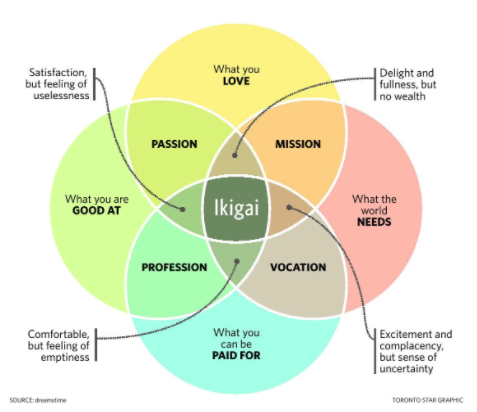
Principles of Ikigai - Diagram
There are only four parameters to experiment with, and then you can sleep soundly knowing you have a reason to wake up in the morning.
The theory is clever and appealing:
It is simple and yet comprehensive
It implies that you can love what you do, contribute to society, and still thrive and prosper
It reinforces the importance of engaging in activities that energize you and fully immerse you in the joy of your creativity (i.e., this is called the “flow state”).
That being said, if you’re like me and most of my clients, chances are you might not find it that easy to answer the questions above. It may even be difficult to strike the right balance between all four of these factors. The Westernized Ikigai method reminds me of some consulting solutions that seem practical on paper but are actually quite complicated to implement on your own. Or, if you prefer, the promise of the magic mirror in Disney’s *Snow White and the Seven Dwarfs*. One reason for this may lie in our Western desire for efficiency and quick results.
The Japanese meaning of "ikigai" may both disappoint and reassure you
Having lived in Japan, I have always felt a bit perplexed when faced with such ecstatic enthusiasm for the concept of ikigai. While Japanese culture places great emphasis on collective continuous improvement (Kaizen), I rarely saw Japanese colleagues overly obsessed with their personal development or their personal contribution to the world through their work. Numbers speak louder than words: In a 2010 survey of 2,000 Japanese men and women, just 31% of participants cited work as their ikigai. That’s not a very significant proportion for the birthplace of ikigai, is it?
Rather than a quick fix for individuals’ sense of purpose and career development, this concept perfectly reflects the Japanese way of life—complex, subtle, yet down-to-earth. Ikigai calls for a slow life rather than a successful career. It is a very democratic and down-to-earth concept of life, open to everyone, and disconnected from the Western view of success.
Neuroscientist and best-selling Japanese author Ken Mogi presents five pillars to help you become your most authentic self:
start small
set yourself free
embrace harmony and sustainability
cherish the joy of the little things
be in the here and n
“Ikigai lies in the realm of small things (...) “Hanami—when the Japanese admire the blooming of the cherry blossoms every spring—is a prime example. You cannot hold on to the experience, and it brings you fleeting joy.”
In other words, you appreciate what gives life meaning when you appreciate the experience of the here and now, when you reconnect with nature, and when you let yourself be part of the larger ecosystem around you.
One might then ask: Is it our calling to be in a state of meditation in our daily lives? To live purposefully, should we avoid the endless cycle of career-building and self-development?
Humility, authenticity, and courage open the door to your purpose
To find your purpose, dare to accept who you are —with your talents, hopes, fears, and areas for growth (not all of which need to be developed!). Being humble enough to understand that you are part of a larger ecosystem is a good start. Knowing how to push yourself to make the most of your unique strengths and the complementary resources at your disposal is another step.
Exercise your free will. On this point, Western and Japanese definitions are in agreement:
“You cannot and should not blame your circumstances for a lack of ikigai. After all, it is up to you to find your own ikigai, in your own way.” (Ken Mogi).
“If you do something on purpose, you do it intentionally, not by accident” (Cambridge)
Recognize that your higher purpose continues to evolve, just as you and your environment do. This is a complex system that cannot be resolved once and for all. Preserve your well-being and joy while pursuing your purpose. Striving to achieve your purpose while sacrificing your health, personal relationships, and self-esteem may not be rational. Yet this is what many people do.
My friend Marie would say, “Stop thinking you’re running up a mountain when you’re actually running on a treadmill.”
Most importantly, you may want to find a balance in all the important areas of your life to ensure that you are living—and will continue to live—happily, sustainably, and with purpose!
When it comes to your career, rather than being the Head of Strategy, how about being the Operator of your meaningful career? Dare to face the reality on the ground. Focus on who you are right now, the kind of world and lifestyle you want to strive for, and the concrete steps you can take to bridge the gap. Of course, circumstances may vary from one situation to another, but your personal intentions should remain the same. Strategies, money, and success should simply be the results of your personal and inner alignment—not the reasons you take action.
UPDATING YOUR CHANGE
A simple tool
Summarizing this purpose in a mantra will serve as a long-term, evolving compass, guiding you along the path you create for yourself.
How and where to start?
It may seem overwhelming and abstract to many people. Here are a few steps that may help you put the different pieces of the puzzle together. I invite you to set aside your judgment, trust your gut, and ask yourself:
What are the top 3–5 elements that need to be balanced to make you happy in life?
What are your own deepest hopes for the world in the future? (You may want to draw or write down 3–5 characteristics that describe the ideal world you want to live in.)
What are my strengths, and what role should I play to turn that dream into a reality?
Once you’re done, you can complete this summary: “I long for a [adjectives] world, where I can find a balance between [nouns], [nouns], and [nouns]. To achieve that goal, my mission is to [verb]. I draw on my [nouns of talents] to make it happen.”
Here is an example: “I long for a humanistic and nature-centered world, where I can achieve a fulfilling balance between my well-being, family, work, intellectual discoveries, and social connections. To that end, my mission is to serve as a catalyst for individual and collective change, so as to position Purpose as a driver of positive impact and serenity. To do so, I draw upon my vision, creativity, connectedness, and listening skills.”
Whenever you're faced with a new decision, ask yourself:
Is it in line with my purpose?
Will this choice allow me to find contentment in the present moment?
How can I better balance the essential factors that make me who I am?
A quote
“‘Thereis no single best way to find ikigai. Each of us must seek our own, in the forest of our unique individualities .’”
Over to you
What is your mantra?
Do you need someone to help you shed light on your path to discovering the many possibilities that await you? Contact me!

How Can You Get Closer to Your Purpose?
Everyone is talking about IKIGAI these days. This Japanese concept is supposed to help people reconnect with what drives them. Ikigai literally consists of iki (to live) and gai (reason).
Although clever and appealing, the Western interpretation of IKIGAI reminds me of the promise of the magic mirror in *Snow White and the Seven Dwarfs*. To simplify your journey, let’s explore the Japanese meaning as well as some simple and practical tools.
"IKIGAI" is often presented as THE solution. What does that mean?
Everyone is talking about Ikigai these days. Although there is no direct translation into English, this Japanese concept is meant to help people reconnect with what drives them. Ikigai literally consists of iki (to live) and gai (reason). This craze can be explained by Westerners’ growing fascination with Japanese culture and their increased search for meaning.
According to the Western interpretation of this concept, all you need to do is be clear about:
your interests,
your strengths,
ways to monetize your efforts,
and ways to address global challenges
to … Jackpot! … find your Ikigai.
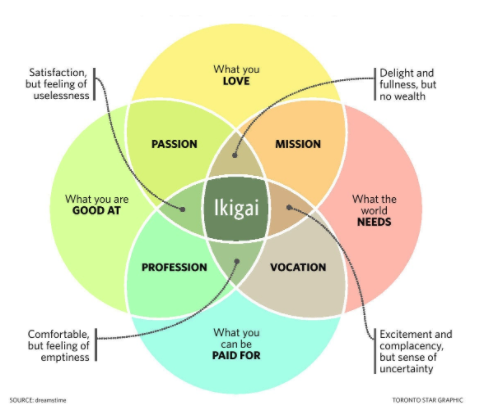
Principles of Ikigai - Diagram
Four variables to play around with, and you can sleep soundly knowing you have a reason to wake up in the morning.
This theory is clever and appealing:
It is simple, yet holistic;
It means that you can enjoy what you do, contribute to society, and, at the same time, thrive;
She emphasizes the importance of engaging in activities that energize you and immerse you in creative enjoyment (what is known as “the flow state”).
That said, if you’re like me and most of my clients, answering the questions above probably doesn’t seem all that simple. Even if you can answer them, you may find it difficult to strike the right balance between these four factors. And if that’s the case, that’s “OK.”
This Westernized approach reminds me of the solutions proposed by certain consultants—solutions that seem practical on paper but are actually quite complicated to implement on your own. Or, if you prefer, it’s a bit like the promise of the magic mirror in *Snow White and the Seven Dwarfs*. Perhaps our thirst for efficiency and quick results explains this contradiction.
The Japanese meaning of the term “IKIGAI” will surely disappoint you… and put your mind at ease!
Having lived in Japan, I’ve always been a bit perplexed by people’s ecstatic enthusiasm for ikigai. While Japanese culture places great emphasis on the pursuit of continuous collective improvement (kaizen), I’ve rarely seen Japanese colleagues obsessed with their personal development and their individual contribution to the world—let alone through their work. Numbers sometimes speak louder than words: in a 2010 survey of 2,000 Japanese men and women, only 31% of participants cited work as their ikigai. That’s a bit low for the birthplace of this concept, don’t you think?
Rather than a quick fix to bridge the gap between our desire for success and our search for meaning in our careers, this concept perfectly reflects the Japanese way of life. It’s about complexity, subtlety, and simplicity. Ikigai calls for a “slow life” rather than a successful career. It is a very democratic and down-to-earth concept of life, open to everyone and disconnected from the Western vision of success.
Japanese neuroscientist and writer Ken Mogi presents five pillars to help us find true fulfillment:
Start small,
Set yourselves free,
Embrace harmony and sustainability,
Cherish the joy of the little things,
Be in the here and now.
“Ikigai lies in the little things (...). Hanami, the time of year when the Japanese admire the cherry blossoms, is a perfect example. You can’t cling to the experience, and it brings you fleeting joy.”
In other words, you appreciate what makes life meaningful when you savor the experience of the present moment and reconnect with the ecosystem that transcends you and surrounds you. This raises the question of whether our purpose lies in our ability to maintain a permanent state of meditation. This seems to contradict all our beliefs. To be in harmony with our purpose, must we step away from the endless cycle of personal and professional development?
The concepts of humility, authenticity, and courage pave the way for us
According to this Japanese philosophy, here are a few key elements—guiding principles—for finding your Ikigai:
Dare to embrace who you are —with your talents, hopes, fears, and areas for growth (not all of which necessarily need to be developed!). Stay humble by reminding yourself that you are part of a larger ecosystem. Continue to push yourself by leveraging your unique strengths and the complementary resources at your disposal.
Exercise and embrace your free will. On this point, Western and Japanese perspectives converge:
"You cannot and should not blame your surroundings for a lack of ikigai. After all, it's up to you to find your own ikigai, in your own way. (Ken Mogi)."
"If you do something with a goal in mind, you do it intentionally, not by accident" (Cambridge)
Recognize that your purpose continues to evolve, just as you and your environment evolve over time and through experience. It is a complex system that cannot be resolved once and for all.
Maintain your inner well-being and enjoyment as you continue your journey. Striving to fulfill your purpose while sacrificing your health, relationships, and self-esteem seems irrational. Yet it’s common.
My friend Marie would say, “Stop thinking you’re climbing a mountain when you’re actually running on a treadmill.”
Take Action to Reconnect
Finding a balance in all the important areas of our lives to ensure that we live fully, sustainably, and peacefully may be more important than pursuing a single goal, however noble it may be.
Instead of being the strategist of your career, how about being both the artist and the driving force on the ground? Let’s try to focus on who we are right now, on the world and lifestyle we aspire to, and on the concrete actions we can take to bridge the potential gap. Of course, circumstances may vary from one situation to another, but our personal intentions should remain the same. Strategies, money, and success should be the consequences of our personal and inner alignment, not the reasons for our actions.
A simple tool
Creating a mantra—a summary of your purpose—can serve as a compass on your long-term journey.
How and where should I start?
"Easier said than done," you might say. All these concepts and recommendations may indeed seem abstract to many people. Here are a few steps that might help you “put the pieces of the puzzle together.” I invite you to set aside your judgment and trust your instincts as you answer the following questions:
What are the key elements that need to be in balance for you to be happy in life?
What are your deepest hopes for the world? (You can draw or write down 3 to 5 characteristics that describe the ideal world in which you want to live.)
What might be your strengths and your role in turning this dream into reality?
Once you've identified these elements, you can complete this summary: “I aspire to a world [adjectives], where I can find a fulfilling balance between [nouns], [nouns], and [nouns]. To achieve this goal, my mission is to [verb]. I draw on my [talents] to make this happen.”
Here's an example:
“I aspire to a humanistic, nature-centered world where I can find a fulfilling balance between my well-being, my family, my work, my intellectual pursuits, and my social relationships. To achieve this goal, my mission is to act as a catalyst for change—both individual and collective—so that my purpose can serve as a driver of positive impact and serenity. I trust in my vision, my creativity, and my ability to listen to make this a reality.”
Whenever you're faced with a new decision, ask yourself:
Does this align with my purpose?
Does this choice allow me to feel good, right here and now?
How can I better balance the important aspects of my life?
The Mantra
“‘Thereis no single best way to find one’s ikigai. Each of us must search for our own, within the forest of our unique individualities.’”
Now it's your turn
What's your mantra?
Do you need someone to help light your path toward discovering the many possibilities that await you? Contact me!
Do you want to become the leader you envision for the world you hope to see? Is it time to discover and assert your leadership? Do you want to embed the concepts of positive impact and purpose at the heart of your organization? Is the challenge to accelerate engagement within your ecosystem to drive systemic change?
If your answer is yes and you’d like some guidance along the way, please contact me! Here’s a link to schedule a exploratory session and the form to further explore your goals and challenges.