

FOOD FOR THOUGHT

Can prioritizing your aspirations make a difference in the world?
My friends and teammates can attest to the fact that I’m a demanding person. I often struggle with setting priorities because I want to do EVERYTHING all at once—and in the BEST way possible (i.e., “perfectly”…). I often say that the priorities are A, B… and C and D because, let’s face it, everything is connected, urgent, and IMPORTANT. Even though this approach allows me to push myself and leverage systemic connections between different areas of my life, it sometimes feels overwhelming.
Have you ever felt like you're trying to juggle too many things at once?
Here are insights and tools to help you find inner peace while making a positive impact on the world.
My friends and teammates can attest to the fact that I’m a demanding person. I often struggle with setting priorities because I want to do EVERYTHING all at once—and in the BEST way possible (i.e., “perfectly”…). I often say that the priorities are A, B… and C and D because, let’s face it, everything is connected, urgent, and IMPORTANT. Even though this approach allows me to push myself and leverage systemic connections between different areas of my life, it sometimes feels overwhelming.
Have you ever felt like you're trying to juggle too many things at once?
If so, trust me, it may take time for you to become the changemaker you want to be while maintaining your inner balance and peace.
If not, lucky you ;). You can keep reading to find ways to help your loved ones who are having trouble setting priorities.
MY JOURNEY - A CASE STUDY
As I set out on my journey to become a certified professional coach, I was leading two projects at my company—and, little did I know, I was on the verge of facing personal and professional consequences from a global viral epidemic. I was full of self-doubt, and yet I was incredibly excited and ready to juggle both worlds, even if it meant waking up at 5:30 a.m.
In 2020, I faced more than my fair share of challenges for the little person that I am.
As a manager, I had to deal with the unexpected departure of team members, as well as the challenge of reassuring and motivating a remote, multicultural team. I had to be agile enough to adapt, maintain, and enhance our projects in order to turn this uncertain period into an opportunity for sustainability. Together, we launched a podcast for environmental change-makers, organized committees of external stakeholders to help our management assess business risks and identify priorities for action, and supported operational teams on key projects such as the launch of sustainable waste collection centers for informal waste pickers.
I oscillated between a sense of flow and imposter syndrome while learning coaching techniques, testing them on clients, and building my blog (you can probably imagine the challenge if I tell you that I still type with just a few fingers on my computer…).
As is often the case with many expatriates, I had to cope with the emotional stress of being barred from traveling back to my home country. That said, I must admit that my situation in Japan was more manageable compared to that of other friends in countries with stricter restrictions.
Worst of all, I was struggling with myself. I was torn between gratitude for my network’s trust (or what I tend to perceive as optimistic gullibility), pride in my team’s dedication, anxiety about the state of our world, and finally, guilt over “not doing enough.” What I mean is that I wasn’t doing enough to help the world compared to my company’s workers who were cleaning up the trash on the streets, or the doctors, nurses, and humanitarian workers who were saving lives.
All that to say, I was really struggling with my “I want to do it all” and “don’t complain” syndromes, until one day, I discovered the balance wheel exercise! Spoiler alert: this isn’t a magic wand… though it’s not far off. This exercise is a very powerful tool for mapping out your priorities while balancing all the important areas of your life.
Thanks to my use of this tool, I gradually gained greater clarity about what was truly important to me and my purpose. I realized that the more I lost my center, the more tired and confused I became, and the less helpful I was to others. So now, whenever I feel overwhelmed, I use this tool to refocus my attention on my deepest aspirations. I can then draw on my values, talents, and wonderful allies to create a virtuous cycle of positive actions. This allows me to move forward—smoothly—despite the unsettling ebb and flow of external circumstances.
***
Updating your change
A SIMPLE Tool
First, ask yourself: What are the important factors that would allow you to live a harmonious life?
Draw a wheel. Divide it into 8 categories and add your ideas in any order you like.
Then, without giving it too much thought, write down your level of satisfaction for each item (with the outer line representing a 10/10 level of satisfaction).
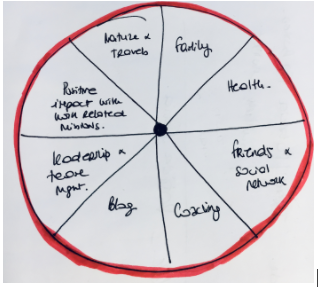
Illustration showing the key issues at stake in 2020
When you look at your wheel, what does that tell you?
If you could improve one thing that would increase your overall level of satisfaction,
What would you focus on?
What specific action—within your control and consistent with your other priorities—could you take?
Let's say you've made progress on this item—what would be your next priority?
***
A MANTRA
“‘Allmen think that happiness is found at the top of the mountain, whereas it lies in the journey of climbing it .’ ”
Over to you
What do you need to prioritize today in order to find inner peace while still being helpful?
Feel free to share how this article resonates with you—I’d love to hear from you. Also, if you’d like support in becoming the leader you want to be for the world you envision, contact me! Here’s a form to help you further explore your ambitions and challenges: English / French

Are we free to choose our own path in life?
Have you ever felt like you were stuck in your life? As a Westerner, I was raised with the mantra, “If you want to, you can.” While appealing, I find the theory of free will a bit too simplistic and oppressive for some people. Let’s discover what real decision-making power individuals have!
The Thought Process
Have you ever felt stuck or frustrated in your life? Personally , I’ve been lucky enough to have some wonderful experiences, but I’ve often found myself dreaming of living on a Greek island, working remotely on topics of my choice and at my own pace.
As a Westerner, I was raised with the mantra “If you want to, you can.” Think of the thousands of decisions we make every day. We’re the only ones who decide whether to jump out of bed or hit the snooze button, whether to take a shower or a bath, or whether to become vegetarian, flexitarian, or a meat-eater. Every day, we make thousands of decisions. That said, while appealing, I find the theory of free will a bit too simplistic and oppressive for some people.
What is OUR true decision-making power?
Being free means being free from external constraints that prevent you from doing or saying what you want. For example, I decided to avoid eating meat and to reduce my fish consumption because I wanted to focus on what was within my control in the fight against climate change, while honoring my values of responsibility and citizenship.
Yet some people will tell me that my friends, my reading, and my work influenced this choice. One might indeed wonder whether our actions are influenced more by our environment than by our rational judgment alone. For example, despite the scientific evidence, some people continue to believe that humans are not responsible for climate change.
To what extent do external factors influence our decision-making?
Many thinkers have demonstrated that events are in fact determined by preexisting causes. The sociologist Durkheim explained that our ideas, thoughts, habits, and actions are strongly influenced by the socioeconomic context in which we live.
According to this line of reasoning, I wouldn't be who I am—some might call me a "bobo" enjoying an international career—without my family's social background, values, and network, among other factors.
I'm sure my background has had a strong influence on my current circumstances. But is everything already predetermined? Are we blind or naive in the choices we make?
What if the path TO freedom depended on our ability to perceive?
Rather than viewing humans as automatons or as all-powerful beings, Freud introduced a third way of thinking with his concepts of the “ego,” “id,” and “superego.” These interacting agents—representing our conscious, unconscious, and subconscious minds—are shaped by our environment, social norms, inner thoughts, drives, and desires. Fundamentally, we are confronted with multiple sources of influence—both intrinsic and extrinsic—as we go about our lives.
To put it (very) simply, through psychoanalysis, we can acknowledge our power and responsibility by bringing our unconscious thought patterns into consciousness. By doing so , we can free ourselves from our limiting beliefs.
Would accepting our determinants increase our freedom?
Having the willingness to recognize and detach ourselves from our internal and external determinants can give us some control over shaping our future. We can change our mindset regarding our circumstances. We can allow ourselves to imagine the future on our own terms and trust our intuition. Yes, it can seem exhausting. Personally, I don’t always succeed. But it’s worth trying because, when it works, the world seems to radiate light and joy!
For the philosopher Descartes, true freedom is achieved when our will and our intellect (unlimited capacity vs. limited capacity) are harmoniously aligned. This premise gives me pause. Is freedom a matter of balance? A balance between accepting our roots as our inner determinants while freely creating our future possibilities; a balance between our physical limitations and our boundless imagination; a balance between our expectations and our trust in the unknown. One opposite nourishing the other to create a liberating fusion.
The Path to Change
THE TOOL
Do you want the freedom to choose your own path in life? It might be a good idea to start by understanding your deepest motivations and potential obstacles, and then align your actions with your expectations.
Easier said than done. I know! Here’s a tip to help you get started: kids’ favorite (and revamped) game… the “Why” game?!
First, think about what you want: “I’d like X”
Next, dig deeper to uncover the underlying need. Ask yourself, “What does X tell me about what’s important to me? I need Y. Okay, what does Y tell me about what’s important to me?” And so on, until nothing more comes to mind.
Finally, go back to the source—to your original desire—to assess how that need might influence your behavior in the future.
THE CASE STUDY
Let’s take the example of a social entrepreneur who wants to recruit women to her organization’s board of directors but is facing resistance from the company’s founders. A conversation with a coach might go something like this:
What does this desire to appoint women to the board of directors say about what is important to you?
Well, it's obvious: equality. And besides, I'm angry because it's clearly not recognized and…
Okay, let's focus a little on this idea, if you don't mind. What does equality give you that's even more important?
Well, recognizing the power of diversity.
And what does this recognition give you that is even more valuable?
Hmm… acceptance of all human beings, no matter who they are. Nothing is more important than that, don't you think?
When you are fully accepted, what changes for you?
I recognize who I am and no longer need external validation. I embrace my own differences and those of others as a gift and an asset.
And how does this shift in perception help you in your lobbying efforts to get more women on the board of directors?
Well, women shouldn't be represented just because they're women. We simply need to find a diverse group of people who will enrich the debate and decision-making process at the board level. So women, yes—but not just anyone, and not only women. In fact, I need to find the talent and experience we’re lacking. If the founders understand the value of having a diverse group of people in our startup, we shouldn’t have to fight for it anymore.
The MANTRA
"Better to correct a mistake than to make none at all."
It comes from Charles Pépin's book *This Is Not a Philosophy Textbook*, which admirably simplifies philosophical concepts without compromising their depth and meaning.
NOW IT'S YOUR TURN!
What decision do you want to make and what experiment do you want to try today?
***
Do you want to become the leader you envision for the world you hope to see? Is it time to discover and assert your leadership? Do you want to embed the concepts of positive impact and purpose at the heart of your organization? Is the challenge to accelerate engagement within your ecosystem to drive systemic change?
If your answer is yes and you’d like some guidance along the way, please contact me! Here’s a link to schedule a exploratory session and the form to further explore your goals and challenges.

Are you free to choose your own path in life?
Have you ever felt stuck in a rut? As I reflect on my life, I realize my journey has been filled with intense and exciting experiences. Still, I’ve found myself dreaming of living on a Greek island, workingremotelyon projects of my own choosing and at my own pace. Have you ever had similar wishes?
As a Westerner, I was raised with the mantra “if you want to, you can.” While appealing, I find the theory of individual free will too simplistic and oppressive for some people. Let’s explore the true power of decision-making that individuals possess!
FINDING MEANING
Have you ever felt stuck in a rut? As I reflect on my life, I realize my journey has been filled with intense and exciting experiences. Still, I’ve found myself dreaming of living on a Greek island, workingremotelyon projects of my own choosing and at my own pace. Have you ever had similar wishes?
As a Westerner, I was raised with the mantra “if you want to, you can.” Let’s think about the thousands of decisions we make every day. We are the only ones who decide whether to jump out of bed or hit the snooze button for a bit, take a shower or a bath, become a vegetarian, a flexitarian, or a meat-eater. Every day, we are the ones who make the final decisions. While appealing, I find the theory of individual free will too simplistic and oppressive for some people.
What degree of autonomy do individuals have when making their choices?
Being free means being free from external constraints, so that you can do or say whatever you want. For example, I decided to stop eating meat and drastically cut back on my fish consumption. Why? Because I wanted to focus on what I could control in the fight against climate change. Besides, I wanted to live up to my values of responsibility and civic duty.
Yet, some people might say that I was actually influenced by my friends, what I read, or my work when making that choice. I can’t help but wonder: What if our actions were influenced by our environment and our thoughts rather than by facts? For example, despite the scientific evidence, some people believe that humans are not responsible for climate change.
Can external factors influence our ability to make decisions?
Many authors have shown that events are actually determinedby by pre-existing causes. Sociologist Durkheim explained that our ideas, thoughts, habits, and actions are in fact strongly influenced by the socioeconomic context in which we live. I wouldn’t be who I am—some people would say a “bobo” enjoying an international career—without my family’s social background, values, and network, among other factors.
I am sure my roots have had a strong influence on my current circumstances. Yet, is everything predetermined for us? Are we blind or naive when we make choices?
What if our freedom depended on our ability to perceive?
Rather than viewing humans as automatons or omnipotent beings, Freud introduced a third way of thinking through his concepts of the “ego,” “id,” and “superego.” These interacting components, representing our conscious, unconscious, and subconscious minds, are shaped by our environment, social norms, inner thoughts, impulses, and desires. Essentially, we are subject to various sources of influence, whether intrinsicsic or extrinsic, as we go about our lives.
Through psychoanalysis, we come to understand that our power and responsibility lie in transforming our unconscious patterns of thinking into conscious ones. By doing so, we can free ourselves from our limiting beliefs.
Would accepting our internal and external determinants increase our freedom?
Having the willpower to acknowledge and distance ourselves from the factors that shape us can give us the power to build our future. We can change our mindset regarding our circumstances. We can allow ourselves to imagine the future on our own terms. Yes, this may seem exhausting. Personally, I don’t always succeed in doing so. But it’s worth a try!
For the philosopher Descartes, true freedom is achieved when our will and our intellect (unlimited versus limited capacities) are harmoniously aligned. It makes me wonder: What if freedom were a matter of balance? The balance between accepting our roots as our inner determinants while freely shaping our future possibilities, the balance between our physical limitations and our boundless imagination, the balance between our expectations and our trust in the unknown.
UPDATING YOUR CHANGE
The tool
Do you want to regain the freedom to choose your own path in life? Start by understanding your deep-seated motivations and obstacles. Then align your actions with your expectations.
Easier said than done. I KNOW! Here are a few tips to help you make a difference: the twisted, four-year-old favorite game of “Why”!
First, think about your wish: "I would like X."
Then keep digging to find the root cause. Ask yourself, “What does X tell me that’s important?” You may discover that you need Y. Repeat the question: “What does Y tell me that’s important to me?” and so on until nothing more comes to mind.
Finally, take a step back and assess how such a core driver affects your behavior.
The illustration
Let’s take the example of a social entrepreneur who wants to bring women onto the board but is facing resistance from the founders. The conversation with a coach might go something like this:
The Coach: What is it about that wish for women at the board level that says something so important about you?
The Changemaker: Well, it's obvious: equality. And I'm angry because clearly this isn't recognized and …
The Coach: Okay , let’s focus on that idea for a moment, if you don’t mind. What does equality offer you that is even more important?
The Changemaker: Well , the recognition of the power of diversity
The Coach: Oh , and what does this recognition bring you that is even more precious?
The Changemaker: Hmm… acceptance of all human beings. Nothing is more important than that, don't you think?
The Coach: What is the value of being accepted fully and completely?
The Changemaker: I recognize myself and no longer need external recognition. I embrace my differences and those of others as gifts and assets.
The Coach: And how does that shift in perception help you with your initiative to advocate for more women on corporate boards?
The Changemaker: Well , women shouldn't be included just because they're women. We simply need to find different people who will enrich the debate and decision-making at the board level. So, yes to women—but not just anyone, and not only women. I need to find the talent and experience we're lacking. If the founders understand the value of such diverse people for our startup, we shouldn't have to fight about it anymore.
The Mantra
“Better an error-corrected one than no error at all”
It comes from Charles Pepin’s book *Ceci n’est pas un manuel de philosophie*, which beautifully simplifies philosophical concepts without compromising their depth and meaning.
Now it's your turn:
What life experiment do you want to start today?
***
What did you find useful in this article? Click the "Reply" or "Comment" button and let me know! Also, if you'd like help finding (or refining) your purpose and increasing your impact on society and the planet through your professional activities, feel free to contact me using this form (English / French)

Three Ways to Avoid Feeling Powerless
Have you ever felt small and helpless in the face of human-caused pollution, natural and public health disasters, or social inequalities? Do you doubt that we can be agents of change, feel empowered, and be genuinely optimistic? One key to success lies in our mindset and our perception of reality. Here are three steps to overcome your fear of powerlessness.
I was recently talking with a friend about how discouraged we were (and sometimes still are) when reading about human-caused pollution, natural and health-related disasters, social inequalities, or similar problems. Thinking about the future of our world can be quite depressing, so much so that sometimes we may lose hope and question the meaning of our actions.
Does this sound familiar? The good news is, you can be a changemaker, feel empowered, and still be genuinely optimistic. One key to success lies in our mindset and our perception of reality.
1. Acknowledge the reality
What resists, persists. Yes, it’s hard to admit just how dysfunctional humans are. But acknowledging this fact doesn’t mean condoning this human and societal condition. When you just keep saying, “It shouldn’t be this way,” without taking constructive action, it’s a bit like standing in front of a house on fire and waiting for it to go out without doing anything to change the situation. Chances are that if you quickly recognize the danger and call the fire department, the situation will be resolved quickly.
Overcome your illusion. In “Loving What Is”, Byron Katie uses “The Work” to help a person accept their reality while answering these questions:
- Is that true?
- Can you know for certain that it is true?
- How do you react when you believe this thought?
- Who would you be without this thought?
Finally, she asks the person to reframe the thought. Let’s take an example: The original thought, “I have no positive impact on society,” would become “My thoughts have no positive impact because they discourage me from changing the way I live and work to make a positive impact” or “I have a positive impact if ….” By realizing this, you move from being a victim to taking responsibility for your interpretation of events and your reaction to them.
This approach may be criticized for its simplicity, especially when dealing with certain complex issues. Yet, it may also help someone become aware of their limiting thoughts and find “a way to change the projector—the mind—rather than the [thing] being projected.”
2. Accept THE duality: YOUR limits and potential
It is acceptable to be part of both the problem and the solution at the same time. As Eastern culture teaches us through the theory of yin and yang, forces that may seem opposite are actually deeply interconnected.
Just by buying food, we create certain sources of pollution. Yet, we can also reduce our impact on the planet by striving for zero waste.
Act consciously in your own way. Yes , we are all, to a greater or lesser extent, responsible for climate change. Yes, it is linked to a larger system of production and consumption. No, that is not a reason to wait for others to act first. If a single individual cannot solve all the world’s complex challenges at once, acting as a “Colibris” (Pierre Rabhi) might help you realign with your values, make a positive impact, and—who knows—create a collective shift toward a caring and responsible society.
3. Refine your strategy to maximize your impact
First, make sure you have a clear understanding of what’s truly important to you and what’s relevant to your professional and personal life. The world’s problems are endless. It’s easy to feel overwhelmed just thinking about them.
To be effective, focus on your goals and be pragmatic. You may want to distinguish between what you empathize WITH and what you want to take action on. Then, decide how to proceed in real life while staying true to your values and hopes for the world.
Get Inspired: A Case Study
Here is a story inspired by a true story. Our character’s name is Sandra. She is a smart and dedicated woman who believes in the leadership of the public sector and the power of collective action. The problem is, she faces drastic budget cuts and what seems like a lack of motivation from her colleagues. She has thoughts like: “I’m isolated; I’m torn between my values and my day-to-day reality. It’s hopeless. I can’t do anything. I can’t even manage to make a simple positive change in my own institution.”
To the question “Is that true?” the answer is a direct and immediate “yes!”
In response to the question, “Can you know for certain that it’s true? What’s the evidence for it?” there is a long silence. Then, “Well, I don’t know. At least, I’m trying. I’ve launched various projects at work. I’m constantly learning, and I’ve cut down on my waste at home.”
When asked about opportunities for hope, she recalls the faint signs she picked up from one or two colleagues. She has found potential allies!
When it comes to possible courses of action, the three women get together, brainstorm alternative ideas, and come up with the idea of creating an urban farm. It’s a way to partner with local stakeholders, grow eco-friendly products, and engage the staff.
They continue to lobby top management leaders in a polite yet quiet manner. Still, the trio keeps planting seeds of change. Eventually, some employees begin to voice their desire for greater commitment from upper management regarding their concerns, but they fear potential consequences for their jobs. What started with three people grows to thirty. They organize group discussions outside of working hours and collectively reinforce their goals whenever possible.
One day, they received a letter from the head of the institution announcing an innovation contest for “sustainable initiatives.” They discovered that the director’s daughter was their greatest ally. She had overheard him complaining to his wife about his inability to address his employees’ requests. For three weeks, his daughter kept asking him what he was doing to contribute to her future. One night, he remembered why he had joined the public sector in the first place: to empower citizens. The very next day, he wrote a letter about the contest!
Unleash Your Power
The best tools are often introspective questions that will elicit the most relevant and practical answers for you. Here are a few you might try answering. Sit in a quiet place, focus on yourself, take a deep breath (or two or three), and give it a try—even if it’s just for one second per question. Listen to the thoughts that immediately come to mind. You’ll be amazed by the power of your mind.
What “fires” do I want to put out?
If you have trouble answering such a direct question, you may want to break it down into manageable parts: What topics interest you or affect you the most? Why is that? What’s the real issue at stake? How does this relate to your daily life? The clearer you are, the easier it will be.
What am I hoping to achieve by focusing on this issue?
Here, you want to dream big. Ask yourself questions like: What do I wish for instead? What would be the ideal scenario? What benefits would that bring, and to whom?
How can I move forward?
Now is the time for realistic planning. If you don't have any immediate answers, perhaps practical steps will become clear if you ask yourself the following questions: "What is the first step I can take? Who can I rely on? What resources will I use? When will I commit to doing so?"
Now it's your turn: Click the button below to share your thoughts and comments with me!
“‘Forgiveyourself for your faults and mistakes, and move on.’”

WHAT IF Responsibility MEANT Impact AND Freedom?
Do you believe that being responsible is either a burden or a price you have to pay for a mistake? Have you ever felt obligated to act a certain way because “it was the right thing to do” or because you felt responsible for supporting someone? Would you like to feel responsible, free, and happy all at the same time? In this article, we’ll explore ways to express our authenticity in a creative and meaningful way—for both you and others.
In our daily lives, being responsible is often seen as a burden or a price to pay for a mistake. “You’re responsible for this mess.” “It’s our responsibility to take care of the planet.” “This isn’t my responsibility—it’s yours.” Who hasn’t felt stressed, angry, or even powerless when hearing statements like these?
Is having to be responsible really that troublesome? Is there an alternative to either suffering from or ignoring our sense of responsibility?
FINDING MEANING
“Where does our responsibility begin and end?”
Originally, the concept of responsibility had a positive connotation. In Latin, “respondere” means “to answer to, to promise in return.” Essentially, it refers to the ability to hold oneself accountable.What should we be accountable for?
Should we still be held responsible if the requests we receive are unrealistic? When your boss asks you to do something that’s impossible given the resources at your disposal, should you try to turn that impossibility into a possibility?
Is it a person’s responsibility to deal with the consequences of others’ irresponsibility? For example, should Greta, a 15-year-old girl, be responsible for tackling the climate crisis caused by previous generations?
The growing awareness of our human responsibility for climate change and epidemics such as the COVID-19 pandemic illustrates a shift in people’s perception of their sense of responsibility. Whereas pre-industrial societies believed that natural disasters were caused by forces beyond human control, modern society holds a different view.
While it is important to face reality, placing the burden of changing human behavior on individuals may be too overwhelming. Rather than empowering us, our reptilian brain tends to trigger our “fight-or-flight” response when faced with such a monumental task. Could we view our responsibilities as a catalyst for expressing our humanity and creativity?
FreeDOM to Determine Our Responsibility
We are neither all-powerful nor powerless. If we cannot change the many circumstances of our world, we can change our perception of it by tapping into our superpower called consciousness.
If we are mindful of how we view a situation— —we have the power to decide what we want to do about it. In doing so, we reclaim ownership of our responsibility.
As Victor Hugo said, “Everything that increases freedom also increases responsibility.” Yes, it is scarier to be accountable for our choices. But isn’t it also exciting to realize that we have the power to influence our environment and control its impact on our lives?
What impact do you want to make?
When faced with a situation, thinking about the reality you want to shape (rather than the effects or causes of that situation) may help you change your mindset regarding the concept of responsibility.
Let’s step away from your rational mind for a moment. Let’s imagine you’re diving in the Indian Ocean. You’re enjoying being immersed in another world and surrounded by nature. You feel at peace… until you see a plastic bag on a coral reef.
Here, you have a few options:
You might think: “What a shame! Nature is being destroyed! People are irresponsible!” You probably feel pretty angry, ashamed, or depressed.
You may decide to do nothing because you have nowhere to put this bag, and there are so many other tragedies at sea that it’s pointless to take this single action.
Alternatively, you might get furious, pick it up, and spend the rest of your dive seething with rage at human society.
Another way to look at it might be: “This is unfortunate and terrible for nature. We need to change the way we produce and consume on land. In the meantime, since I saw it, I can pick it up even though it’s not convenient. At least it will be one less threat to the fish.” Proud of your sense of responsibility, you enjoy the rest of your diving experience.
Some will say that this reframing of the situation is a form of brainwashing by positive psychology. Others will think that we won’t save the planet by focusing on an individual’s small actions. Still others may simply wonder what the “right” attitude is to have in this situation.
Honestly, this question is too complex to have a single, simple answer. It’s up to you to decide what you want to think and do in a given situation. Your impact depends on YOUR CHOICE.
Updating your change
A SIMPLE TOOL
When you're faced with an obstacle, a fear, or rejection, why not take a step back and ask yourself:
What are the facts?
What thoughts are causing me to feel a negative emotion?
What do I want to be like instead?
How can I act in a way that makes me feel the way I want to feel?
Here is an example:
Facts: A business leader explains, “Sustainability is, at best, the icing on the cake—something to be addressed only once everything else has been taken care of and if time and resources permit.”
Thoughts & emotions: “This is so wrong. With this kind of thinking, our world will come to an end pretty soon. I can’t work with people like that. I feel hopeless, exasperated, and drained.”
Ideal me: responding with empathy, trying to understand the person’s true needs and finding smart ways to demonstrate the added value of sustainability
Aligned action (among many others): “Do you feel overwhelmed and under pressure from all the business development and cost-saving targets you’re facing?” If so, “How about discussing your challenges and seeing if we can come up with some sustainable solutions?”
A MANTRA TO ACCOMPANY YOU
“‘Ifyou own this story, you get to write the ending .’”
Now, back to YOU! How do you want to take charge of your story today?
***
Feel free to share how this article resonates with you—I’d love to hear from you. Also, if you’d like help finding (or refining) your purpose and increasing your impact on society and the planet through your professional activities, feel free to contact me using this form (English / French)

Can I be helpful to others and love myself at the same time?
Have you ever felt torn between the desire to be helpful to others and the need to ensure your own well-being and achieve your goals? Do you sometimes find it difficult to decide when to give, to whom to give, and when to receive? If so, you’re not alone! This short article will provide you with some insights and tools to help you feel balanced and make a meaningful impact.
AN ENLIGHTENING STORY
(adapted from a true story)
Lana is a high achiever and a corporate change-maker. Her greatest motivation in life is to be useful: useful to others, useful to projects, and useful to good causes. Until recently, her identity was shaped by her ability to always be there when someone needed advice, a listening ear, or “a helping hand” for a project. She was thrilled to be the go-to person who brightened the lives of others.
As a superwoman, she kept organizing her life and multitasking to anticipate the needs of her loved ones, colleagues, and even strangers. Yes, it was exhausting—and sometimes even isolating. Being everyone’s savior often meant neglecting her own needs and desires. But she saw no other options for herself. In her own words, “This [was] the normal life of a dedicated, working woman.”
Together, we explored—without judgment—what “being useful” meant to Lana. We looked for the underlying beliefs that were fueling such an all-consuming need to be useful. As it turned out, the idea of usefulness was linked to her need for acceptance. To avoid rejection, she believed she had to be the perfect daughter, student, colleague, boss, friend, mentor, mother, and lover. Being perfect meant satisfying others.
In reality, she was turning herself into a “tool for pleasing others,” and it felt as if she could never fully please herself or satisfy others. It was a vicious cycle. One day, she realized she was giving to others out of a sense of guilt and misery rather than love and selflessness. While advocating for the importance of self-love to others, she was the first to reject any help or opportunities to take a well-deserved rest. She was lying to herself and others, and this had to stop.
Even though Lana was consciously eager to change, a part of her was resisting. Was she “allowed” to start putting herself first? Was she willing to risk losing her sense of identity? Who would she become? She was terrified. It was as if she were standing on the bank of a river, desperately trying to reach the other, alluring side, but afraid to cross what seemed like a torrent of rushing water.
To address her recurring objections, we used a coaching tool called the “core outcome exercise.” Lana came to understand that those mixed feelings were different parts of herself crying out to be heard. We listened respectfully to each positive message behind her feelings. She recalled her most important values in life: human fulfillment, freedom, and joy. To her, anyone who is fully aligned with themselves is able to realize their full potential to meet the world’s needs. She used to think that her fulfillment depended on how useful she would be to the people she encountered. But in striving to please others, she lost sight of her own freedom and joy, and lost herself and her ability to make her greatest impact. Instead of expressing her values, she was modeling an ineffective counterexample.
With that realization in mind, she reevaluated her past, inner beliefs, and developed a more liberating mindset. She established a morning routine and a decision-making tool that helped her respect her own needs and find the courage to choose whom and what to support. She completely transformed her approach to engagement and began to lead by example. She demonstrated that being of service to others depends first and foremost on self-love.
THE TOOLS
Does this story sound familiar?
Do you want to be helpful even though you still have some trouble deciding when to give, to whom to give, and when to receive? In your desire to be helpful to others, are you afraid of being seen as a fraud if you don't always put the needs of those you help before your own?
If so, you're not alone, and you CAN find a balance! Imagine you're a sponge. If you want to help clean surfaces, keep releasing the water you're holding inside. Otherwise, you won't be able to absorb any more water.
***
To help you make a change, here are a few tips:
When you start your day (or while reading this article), ask yourself:
“How do I want to present myself today?” You might say, “peaceful, excited, or even confident.”
“In that regard, what are the three actions—one for myself, one for my personal life, and one for my work—that I want to take today?” If external requests start piling up during the day, delegate and postpone tasks as needed to focus on your priorities.
During the day:
Pay attention to your body’s signals. If you have a headache, cravings, or tension in your body, chances are you’re suppressing and resisting an inner need.
Go to a quiet place (this could be the bathroom or even just closing your eyes) and ask yourself, “What do I need right now?” You may not be able to meet that need right away. Still, acknowledging your need and setting aside some time to address it will help prevent tension from escalating.
If someone insists and resorts to emotional blackmail, simply saying, “I hear you. Today is complicated. I’ll get back to you!” might do the trick. Jot down the request so you can figure out the best way to handle it in the next few days (not today!).
***
And YOU, how well do you balance self-care with caring for others?
***
What did you find useful in this article? Click the "Reply" or "Comment" button and let me know! Also, if you'd like help finding (or refining) your purpose and increasing your impact on society and the planet through your professional activities, feel free to contact me using this form (English / French)